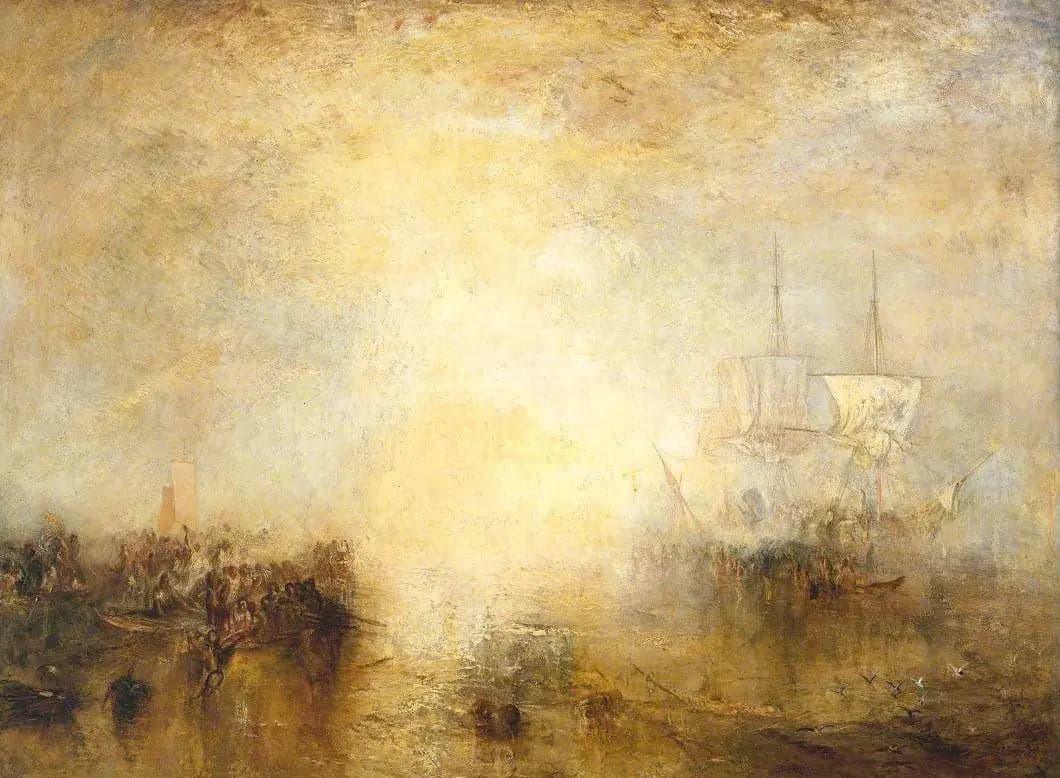
‘Hurrah! for the Whaler Erebus! Another Fish!’
- Original dimensions
- 90.2 x 120.6 cm
- Museum
- Tate
- Year
- 1846
Scene depicted
The painting depicts a dynamic scene of whaling, where the excitement of the sailors and the tumultuous sea meet in a chaotic dance. The golden light caresses the waves, evoking a struggle for survival, both heroic and tragic, immortalizing a moment of exhilaration in the face of untamed nature.
Historical context
Created in London in 1846, this painting is emblematic of the romantic movement, where Turner exalted nature and the infinite. It is a poignant testimony of an era when the sea was not only a source of life but also a mystery. Today, the canvas rests majestically at the Tate museum, where it continues to inspire art admirers.
Place in the artist's career
In Turner's career, this painting reflects an artistic maturity. After works such as ‘The Snow Storm’ and 'The Calm River', ‘Hurrah! for the Whaler Erebus! Another Fish!’ marks a transition to a deeper exploration of natural elements, a stylistic peak that foreshadows his later creations.
Anecdote
Turner once confided: "The spirit of the sea is captured in every fluffy movement of water." Perhaps this inspiration came to him one sunny morning, listening to the whisper of the waves near the harbor, reflecting the passion of an artist in search of the sublime. This emotion resonates deeply in the vibrant painting of the masterpiece .