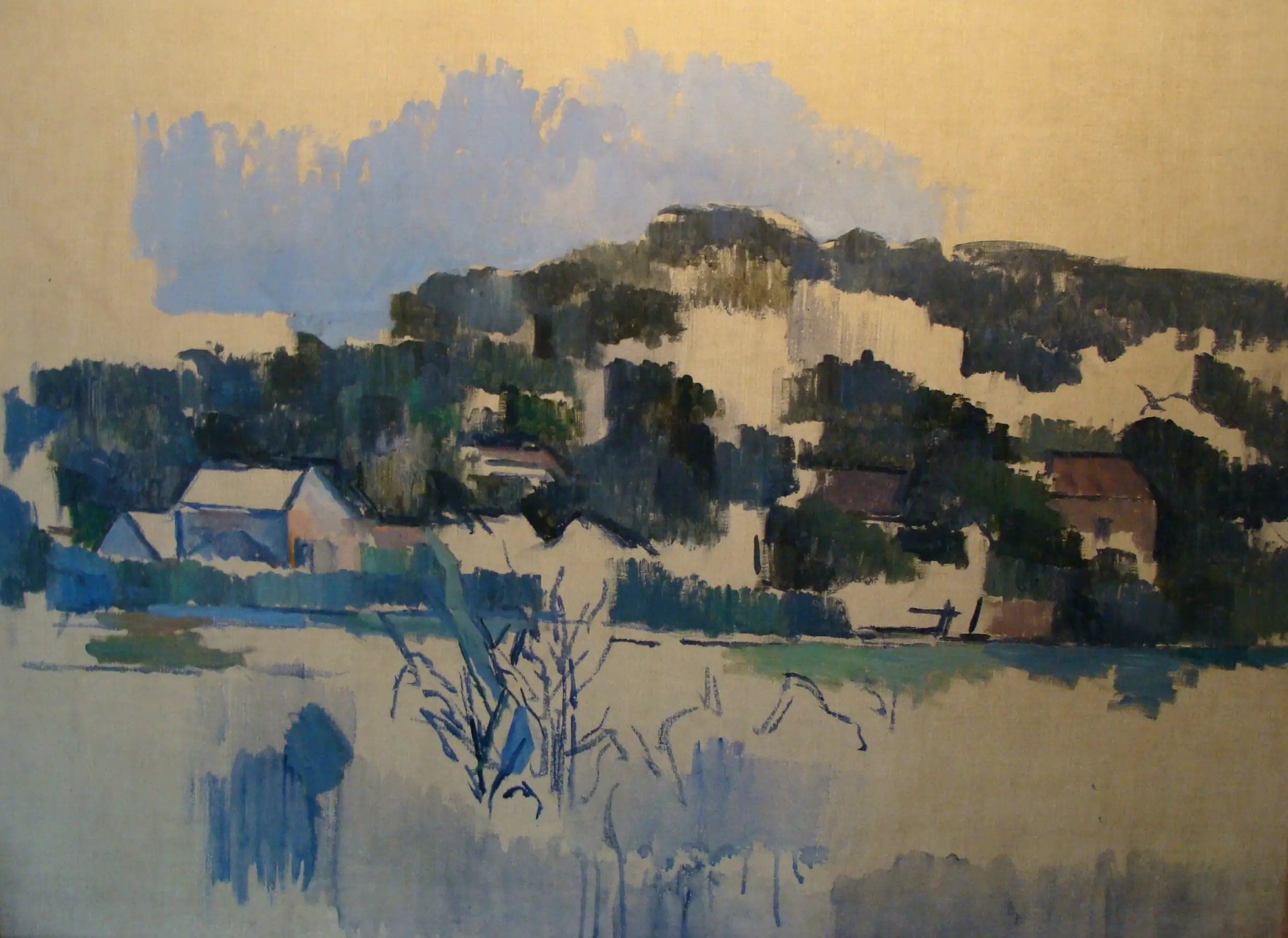
Houses on the Hill
- Original dimensions
- 79.5 x 60.3 cm
- Museum
- McNay Art Museum
- Year
- 1904
Scene depicted
This canvas delicately presents a group of houses perched on a verdant hill, characteristic of Provençal landscapes. The earthy tones and geometric shapes illustrate not only a rural scene but also an invitation to contemplate the beauty of human constructions in harmony with the surrounding nature. The serene atmosphere emanating from this painting suggests a hidden human story behind every wall and every window.
Historical context
Created in 1904, this painting is an iconic work by Paul Cézanne that belongs to the artistic circle of the late 19th century in Aix-en-Provence, the birthplace of the famous painter. It is part of the post-impressionist movement, which seeks to explore the structure of compositions while celebrating the landscapes of Provence. Currently, the canvas is displayed at the McNay Art Museum , revealing its living heritage. Its dimensions, 79.5 x 60.3 cm, evoke a strong and stimulating presence.
Place in the artist's career
Situated in the heart of Cézanne's career, Houses on the Hill represents a phase of maturity where the artist begins to move away from impressionist techniques to embrace a nascent abstraction. Alongside works such as The Montagne Sainte-Victoire and The Fisherman's House , we discover an evolution marked by the search for structure and color, revealing a Cézanne in full creative effervescence.
Anecdote
In a breath of inspiration, Cézanne is said to have remarked: "One must see things as they are and sometimes as we would like them to be." It was on a fresh spring morning, while he wandered the golden hills of his native region, that he drew the very essence of his masterpiece : a peaceful view of houses bathed in the light of a dawning day, touching the heart and provoking meditation.