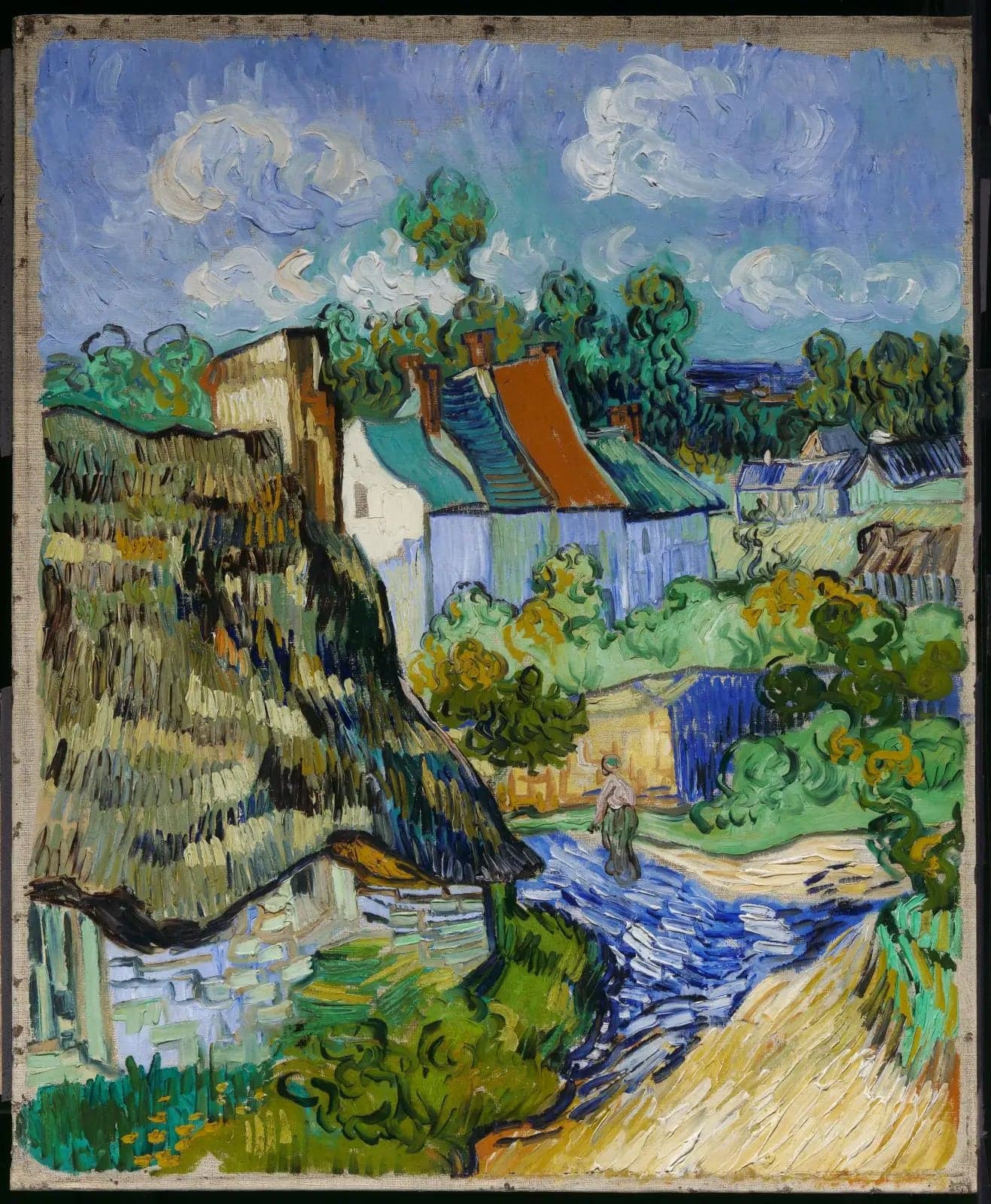
Houses at Auvers
Scene depicted
The painting “Houses in Auvers” depicts modest dwellings, surrounded by a lush and soothing landscape. Each house, tinted with vibrant colors, seems to tell a story, a daily life imbued with the serenity so dear to Van Gogh. The artist captures the beauty of simplicity, rooted in his affection for this region where he spent his last days.
Historical context
Created in 1890 in the heart of the charming village of Auvers-sur-Oise , this painting is emblematic of the post-impressionist movement. This canvas, currently displayed at the Museum of Fine Arts in Boston , is a window into the troubled universe of Vincent van Gogh . Its dimensions, 61.9 x 75.6 cm, resonate with the authenticity and emotion that characterize his work.
Place in the artist's career
“Houses in Auvers” is situated at a turning point in Van Gogh's career, symbolizing a period of maturity where his technique refines. Alongside masterpieces such as “ The Starry Night ” and “ The Sunflowers ”, this canvas reveals a technical evolution, moving from an exploration of color to an intimate relationship with light and forms.
Anecdote
“I seek to capture the light that dances on the facades” Van Gogh might have whispered while creating this masterpiece . One morning, as the mist rises over the houses of Auvers, the artist discovers a harmony between architecture and nature, an inspiration that transcends time. This canvas then becomes a reflection of his deepest thoughts.