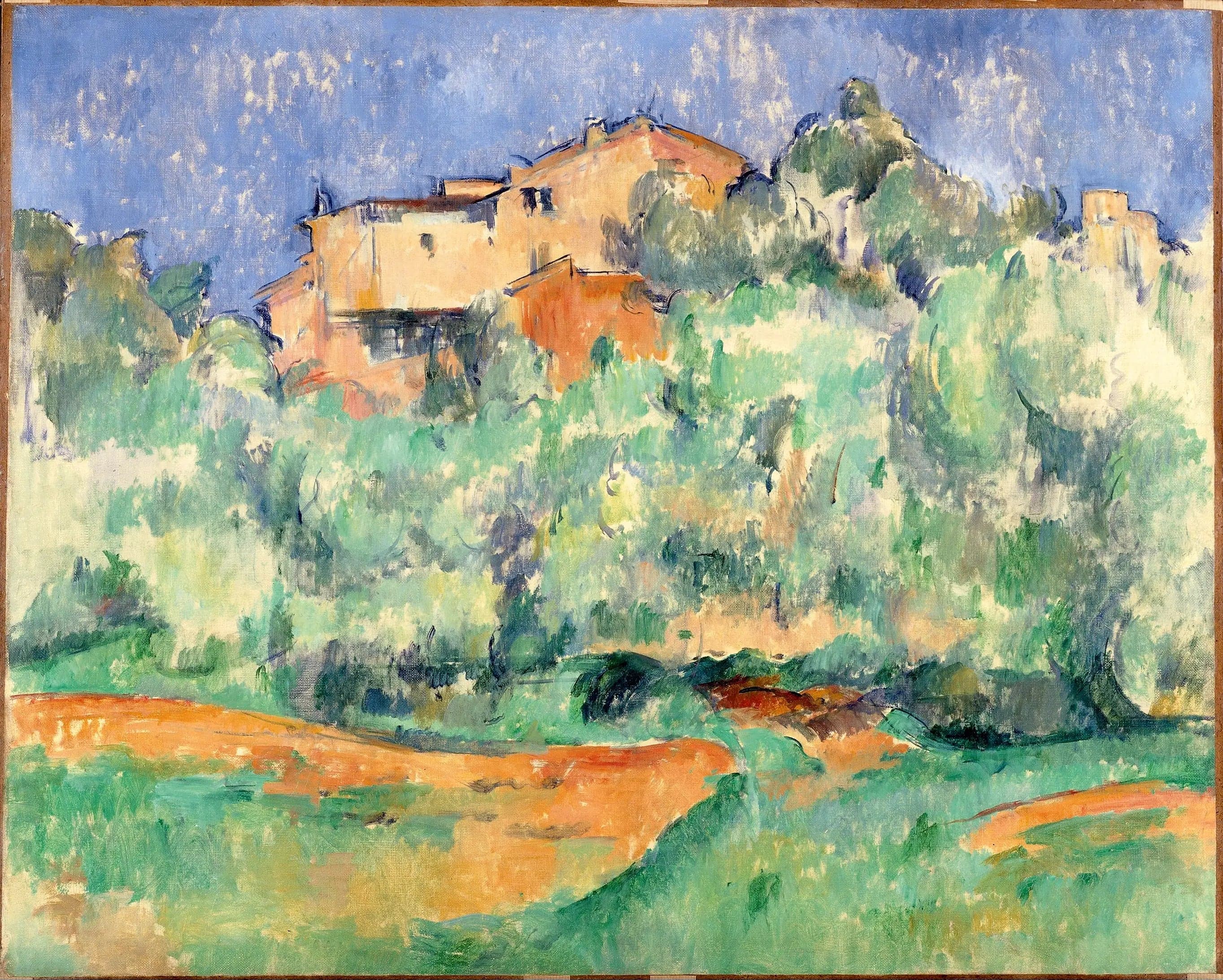
House of Bellevue and Dovecote
- Original dimensions
- 81 x 66 cm
- Museum
- Folkwang museum
- Year
- 1890
Scene depicted
In this painting, the softness and tranquility of the French countryside are honored. The gaze gets lost in a landscape where nature and habitation intertwine harmoniously, inviting a silent contemplation of rural life. The light filtering through the foliage, as well as the rustic architecture of the dovecote, evokes a serene atmosphere, reminiscent of the calmness of summer days.
Historical context
Conceived in 1890, during the beautiful era of Impressionist art, the painting titled Maison de Bellevue et pigeonnier emerges from Auvers-sur-Oise, a village that saw many artists, including Cézanne, capture the beauty of nature. This unique composition, representing a house surrounded by its dovecote, is now exhibited at the Folkwang museum , where it continues to inspire generations of visitors with its striking dimensions of 81 x 66 cm.
Place in the artist's career
Maison de Bellevue et pigeonnier is situated in the midst of Cézanne's mature period, where he began to forge his own distinctive style. This painting superbly dialogues with other masterpieces of his such as La Montagne Sainte-Victoire and Les Grandes Baigneuses , revealing an evolution towards a more pronounced emotional abstraction while maintaining a solid grounding in the representation of reality.
Anecdote
Cézanne once stated: "Art is a means of escape, it must reflect the human soul." It is probably with this conviction that he found his inspiration to create Maison de Bellevue et pigeonnier . Perhaps he was touched by the sweetness of a spring morning, as he observed the light playing through the branches of the trees and the facade of the house, a scene that allowed him to transcend simple reality into a vibrant pictorial work.