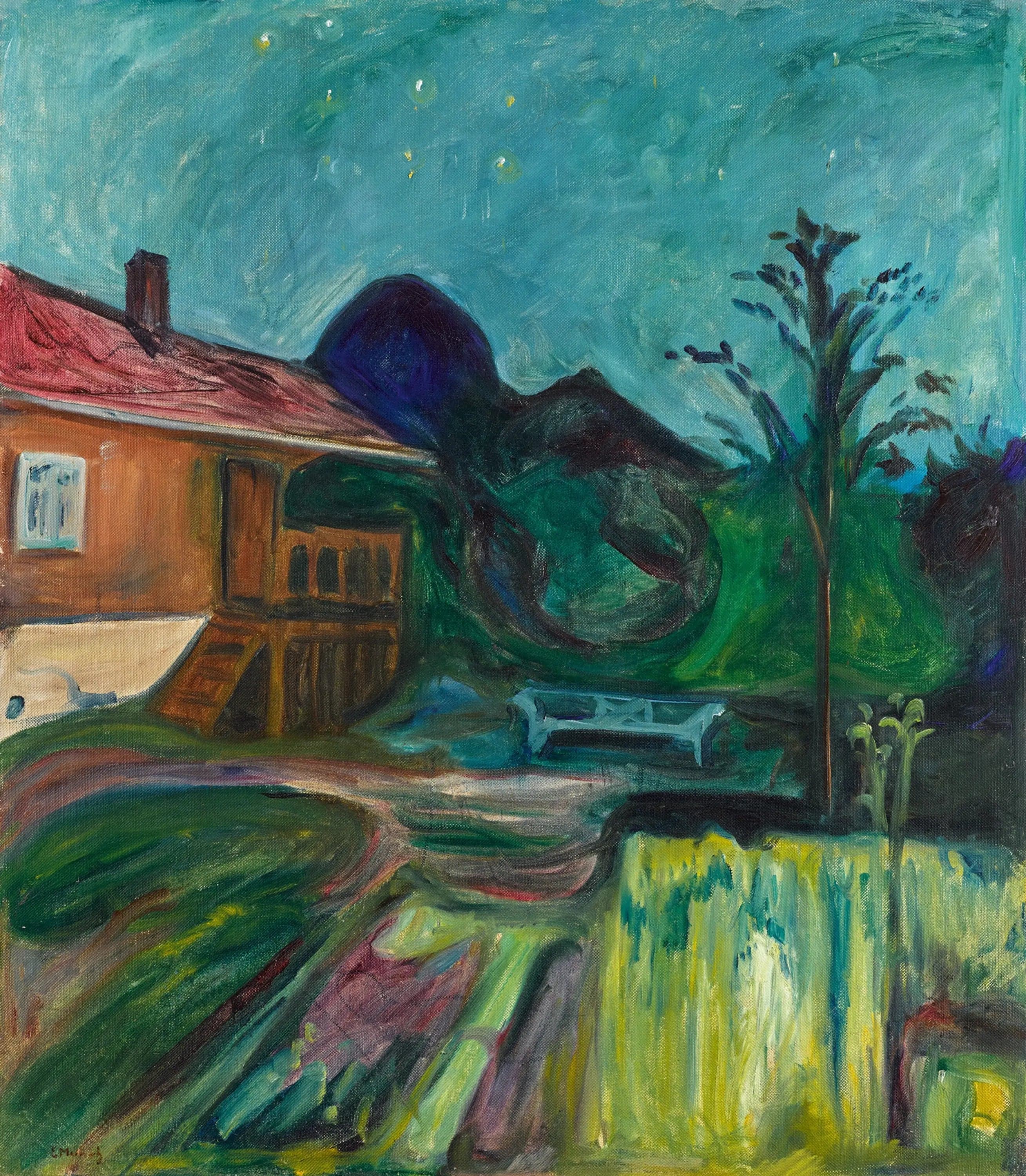
house in the summer night
- Original dimensions
- 101.5 x 115.5 cm
- Museum
- Not specified
- Year
- 1902
Scene depicted
The painting “house in the summer night” presents a striking view of an isolated house under a night sky, illuminated by twinkling stars. A dreamy and serene atmosphere emerges, inviting reflection on the passage of time and solitude. The dark colors contrast harmoniously with the bursts of light, creating an atmosphere that captivates the viewer and envelops them in contemplative silence.
Historical context
Created in 1902, the painting emblematic of Edvard Munch is the result of an intense period of creativity in Oslo, Norway. This canvas , which is part of the expressionist movement, reflects a rich cultural environment, where nature and human emotions meet in a poignant way. At the time, Oslo was a hub for artists seeking to express deep inner feelings. The painting remains today untraceable in known museums, but its impact endures.
Place in the artist's career
This painting is situated at a turning point in Munch's career, where he begins to refine his unique style. It recalls his previous works such as “Anxiety” and “The Scream,” while heralding the more complex explorations of his later creations. The link between deep emotions and natural landscapes begins to solidify, making this canvas essential for understanding his artistic evolution.
Anecdote
“Inspiration can arise from a light breath, from a whisper of shadow.” Edvard Munch often captured moments of disturbed tranquility. It was on a cool summer night, cradled by the soft whisper of leaves, that he imagined this pictorial work . The melancholy embedded in this painting evokes a deep nostalgia, as if the lights of the night soothe the soul.