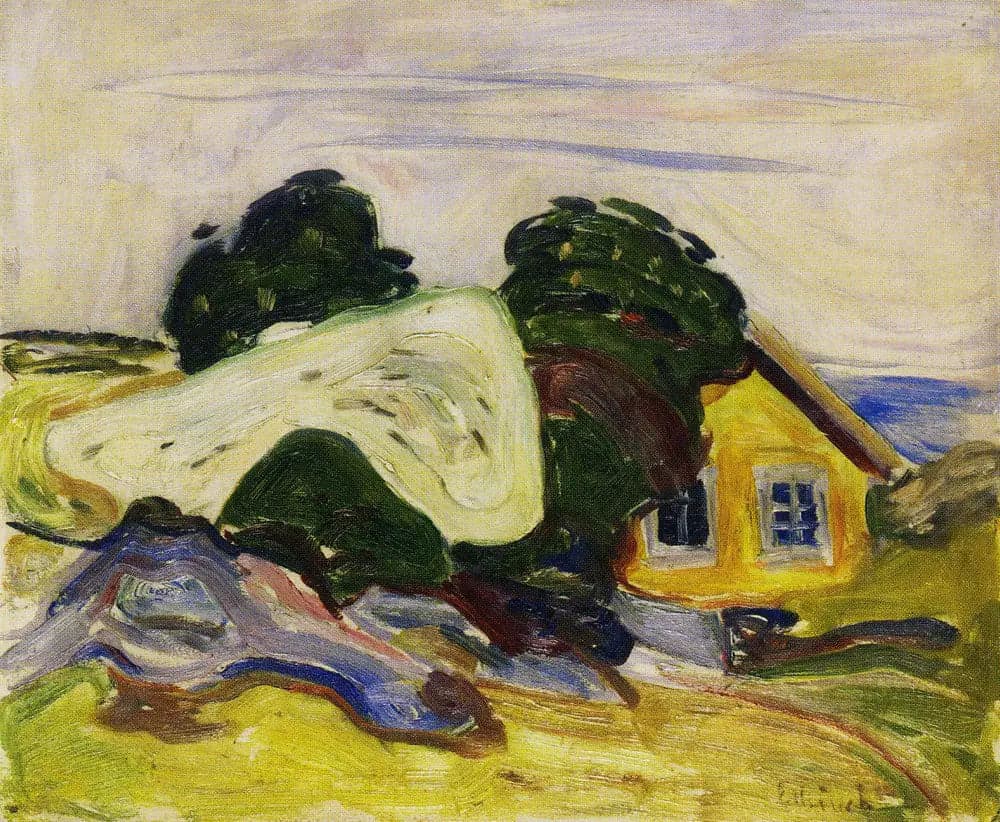
house in Åsgårdstrand
- Original dimensions
- 54 x 45.5 cm
- Museum
- Not specified
- Year
- 1905
Scene depicted
“house at Åsgårdstrand” is a fascinating exploration of the interaction between architecture and landscape. The canvas depicts a house with delicate contours, bathed in soothing light, while the calm sea reflects the sky of a pure blue. The surrounding nature invites itself into the heart of the composition , creating a harmonious dialogue that touches the soul. Each element of this painting tells a story, a pause in time, where the artist captures not only the view but the emotions tied to it.
Historical context
Created in 1905, the painting "house at Åsgårdstrand" by Edvard Munch is part of a pivotal moment in the expressionist movement, where each brushstroke lived with intensity and emotional truth. Located in Åsgårdstrand, this work corresponds to a time when Munch intimately explored themes of nature and solitude. Although the canvas is not part of a known museum collection, its dimensions reveal a delicacy and an intimate approach to its subject.
Place in the artist's career
“house at Åsgårdstrand” appears as a milestone in the artistic evolution of Edvard Munch . After his iconic works like “The Scream” and “The Madonna,” this painting shows a phase of seeking serenity and beauty in simplicity. It anticipates more introspective themes, reflecting on man in the face of nature, and fits perfectly into his maturity period, where emotion is expressed in stripped-down yet powerful hues.
Anecdote
“I paint what I feel. The morning light is a soft whisper, an invitation.” Edvard Munch might have thought this while standing in front of the house at Åsgårdstrand, cradled by the gentle songs of the waves and the salty scent of the sea. That morning, the magic of the painting burst forth from his mind, elevating the composition to a spiritual dimension that transcends its simple representation.