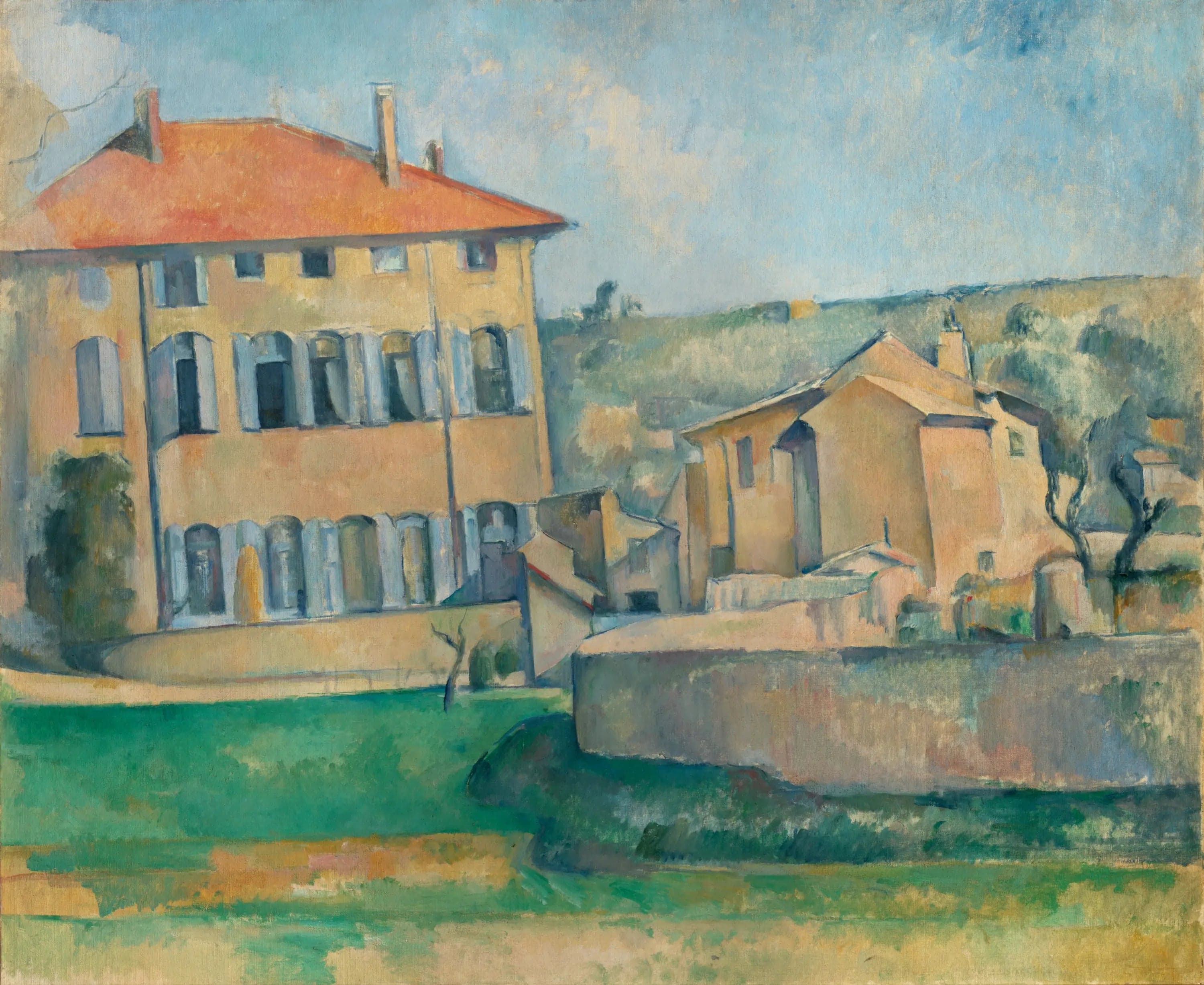
House and farm of Jas de Bouffan
- Original dimensions
- 73.8 x 60.8 cm
- Museum
- Veletržní palác
- Year
- 1887
Scene depicted
This pictorial work depicts the lush and bucolic landscape of the Provençal hills, highlighting the ancestral home, a symbol of familial attachment. Cézanne, as a master of forms, captured the soft lines and colors of a cherished territory, thus revealing the harmony between nature and architecture.
Historical context
Created in 1887, the painting emblematic "House and Farm of Jas de Bouffan" embodies the very essence of the Genius of Provence. Located in Aix-en-Provence, this work unfolds in the context of post-impressionism , a revolutionary movement merging light and structure. Today, this canvas is preserved at the Veletržní palác , testifying to a living artistic heritage. Its generous and enveloping dimensions immerse us in a space that is both intimate and vast, characteristic of the Cézanne universe.
Place in the artist's career
"House and Farm of Jas de Bouffan" is situated at a turning point in Cézanne's career, marking a step towards his embryonic expressionism . Alongside "The Card Players" and "The Sainte-Victoire Mountain," this canvas technically and emotionally evolves him, exploring landscapes that speak of his identity and experiences.
Anecdote
"I wish to paint this light, this earth, this soul," could have murmured Paul Cézanne while contemplating the landscape. This masterpiece finds its origin in a peaceful morning in Aix-en-Provence, where the artist fervently questioned nature. This moment of calm and awakening is reflected in the painting , revealing the emotional power of the canvas .