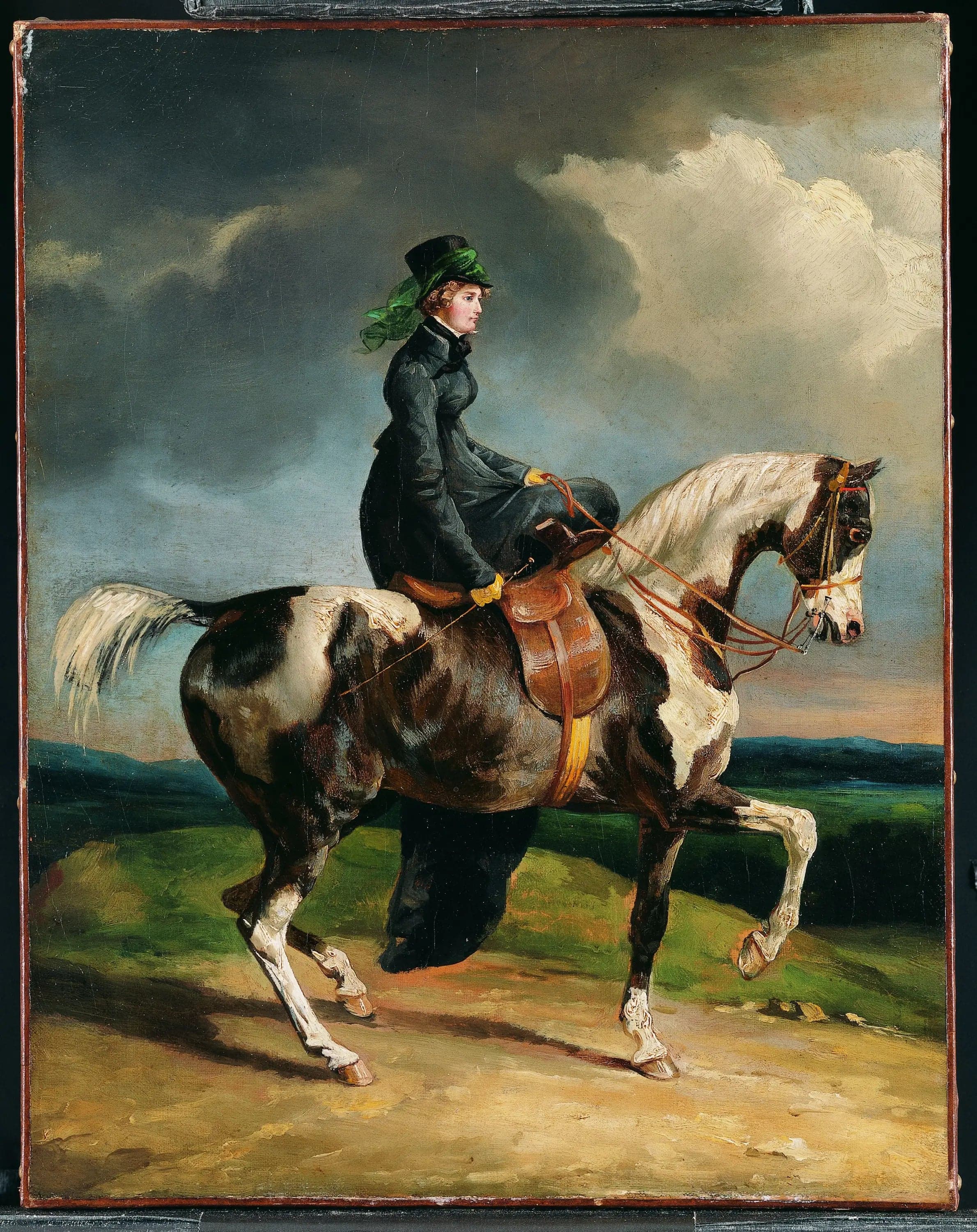
Horsewoman
- Original dimensions
- 34.9 x 44.5 cm
- Museum
- Metropolitan Museum of Art
- Year
- 1822
Scene depicted
"Cavalier" evokes a timeless elegance. The composition presents a woman, majestic in her demeanor, on her proud mount, which seems to move with grace and determination. The carefully crafted details testify to Géricault's finesse and the respect he holds for the nobility of the subject. Through this painting , the viewer is transported into a scene where the movement of the horse and the beauty of its rider merge, refreshing the spirit in the vast landscape of a bustling past Paris.
Historical context
Created in 1822 in the heart of Paris, this painting stands at the crossroads of the emerging romanticism , an artistic movement that advocates the exaltation of human passions and the reevaluation of nature. A centerpiece of the Metropolitan Museum of Art , the canvas "Cavalier" captures the essence of an era shaken by the socio-political upheavals of the French Revolution. The delicate dimensions of this canvas testify to a timelessness, where each brushstroke evokes a depth that time cannot alter.
Place in the artist's career
"Cavalier" stands as a pioneering achievement within Géricault's career. It is a testament to his period of maturity, where he draws from his influences to embark on more ambitious works like " The Raft of the Medusa ". Alongside the canvas " The Cuirassiers ", one discerns the evolution of his style, a constant quest for authenticity and emotion in each painting .
Anecdote
“The beauty of life is often found in its fleeting moments.” It was by drawing inspiration from the faces encountered in a dark alley of Paris that Géricault saw the features of the painting that immemorially bears the imprint of his emotions. That morning, the vibrant atmosphere and the smell of wet earth enveloped his mind, translating into a pictorial work full of light and life.