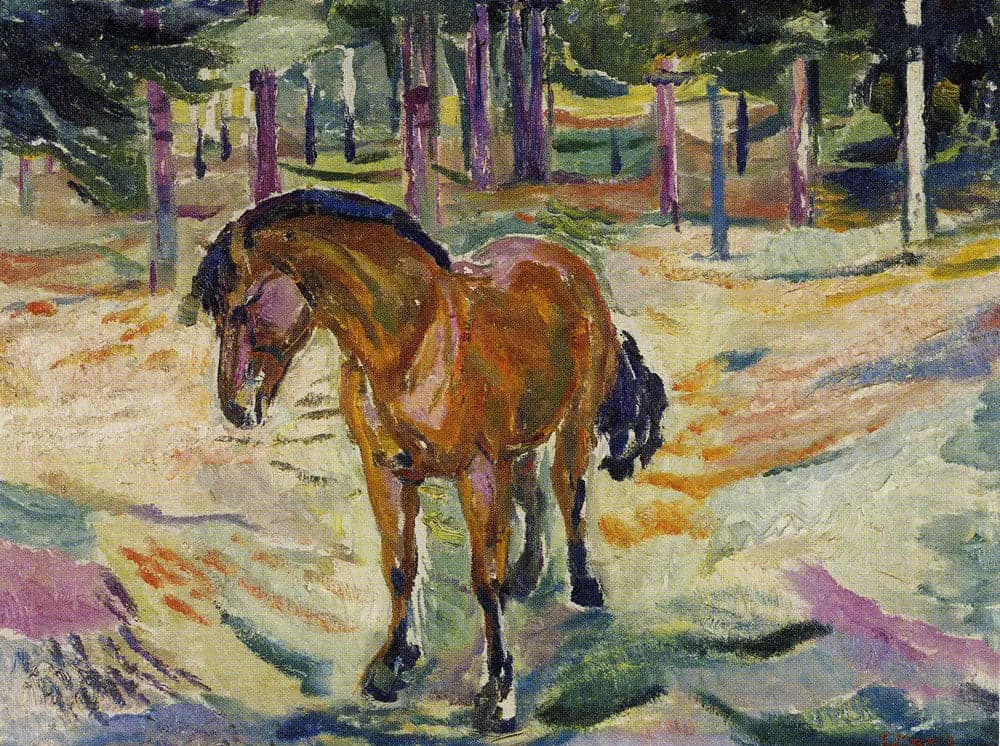
Horse in a Landscape
- Original dimensions
- 90.5 x 68 cm
- Museum
- Not specified
- Year
- 1912
Scene depicted
In this pictorial work, the artist immortalizes a horse majestically moving through a peaceful landscape, both wild and tender. The composition unfolds, evoking a fragile harmony between the animal and its natural setting. The play of shadow and light, as well as the delicate movements of the painting , infuse the whole with an atmosphere of serenity and wonder, an invitation to contemplate the alchemy of nature.
Historical context
Created in 1912, this painting is emblematic of a period of artistic upheaval, at the heart of expressionism . The canvas immerses the viewer in the intimate universe of Edvard Munch , illustrated in a geographical setting as vibrant as it is poetic. Currently, the painting is subtle and mysterious, oscillating between private collection and exhibition, enhancing its fascinating aura.
Place in the artist's career
This painting marks a turning point for Edvard Munch , signifying a period of creative maturity. Compared to other paintings such as “The Scream” and “The Madonna,” this work reveals an evolution towards a more serene representation of his recurring themes. Munch's mastery captures raw emotion while hinting at a softness, thus enriching his artistic journey.
Anecdote
“Nature is my inner reflection,” said Munch. The inspiration springs from a walk by a misty lake, one morning when the silence and beauty of the world intertwined. This painting is the result of an ephemeral moment, capturing a dialogue between the artist and his environment. Thus, each brushstroke of this canvas resonates with the echo of that precious moment.