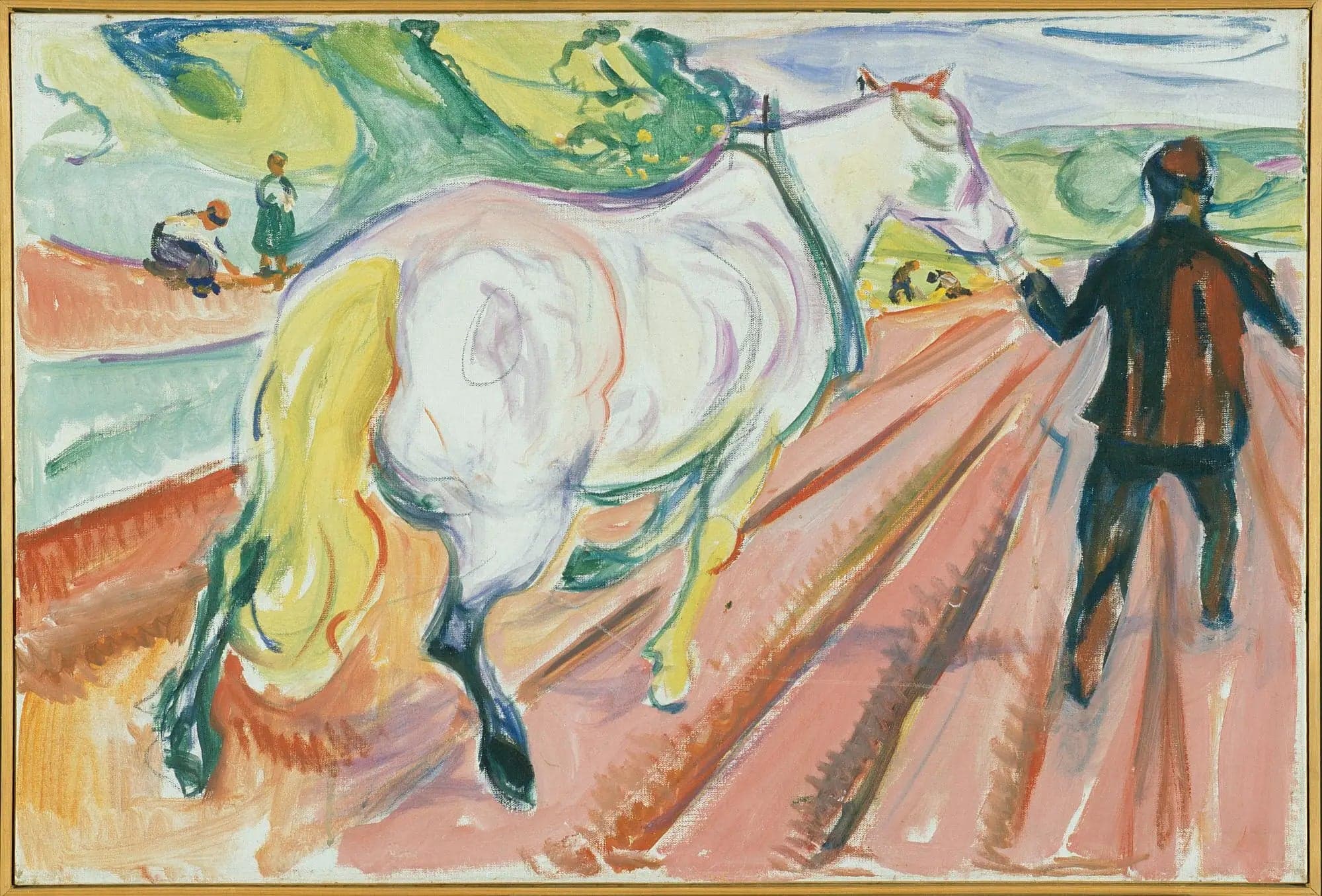
Horse and Man in the Field
- Original dimensions
- 81 x 55 cm
- Museum
- Munch Museum
- Year
- 1917
Scene depicted
In Horse and Man in the Field , the composition highlights the encounter between man and his faithful companion, the horse, in a vast green field. The scene illustrates a sublime and intimate connection, imbued with a palpable serenity, while evoking the existential struggles of the individual in the face of nature. Munch translates here his love for the rural world and his quest for harmony.
Historical context
Created in 1917, this canvas is emblematic and takes root in Oslo, during a vibrant era marked by expressionism . Munch, with his distinctive style, captures the essence of human emotions while exploring universal themes of life and death. The painting is currently housed in the Munch Museum, where it continues to inspire and move visitors from around the world.
Place in the artist's career
This painting holds a significant symbolic place in Munch's career, marking a period of creative maturity. At this time, the artist frees himself from the constraints of formalism to explore deeper emotions. Compared to works such as The Scream and The Madonna , Horse and Man in the Field reveals an evolution in his emotional approach and a growing technical mastery.
Anecdote
“In every breath of wind, I hear the melody of nature, a call for harmony between man and animal,” he is said to have declared while contemplating his masterpiece. Imagine Munch, one spring morning, in a field vibrant with life, where the subtle sounds of the earth resonate with the heartbeat of a horse, inspiring him to capture their rise on the canvas .
Major exhibitions
Munch og Ekely: 1916-1944