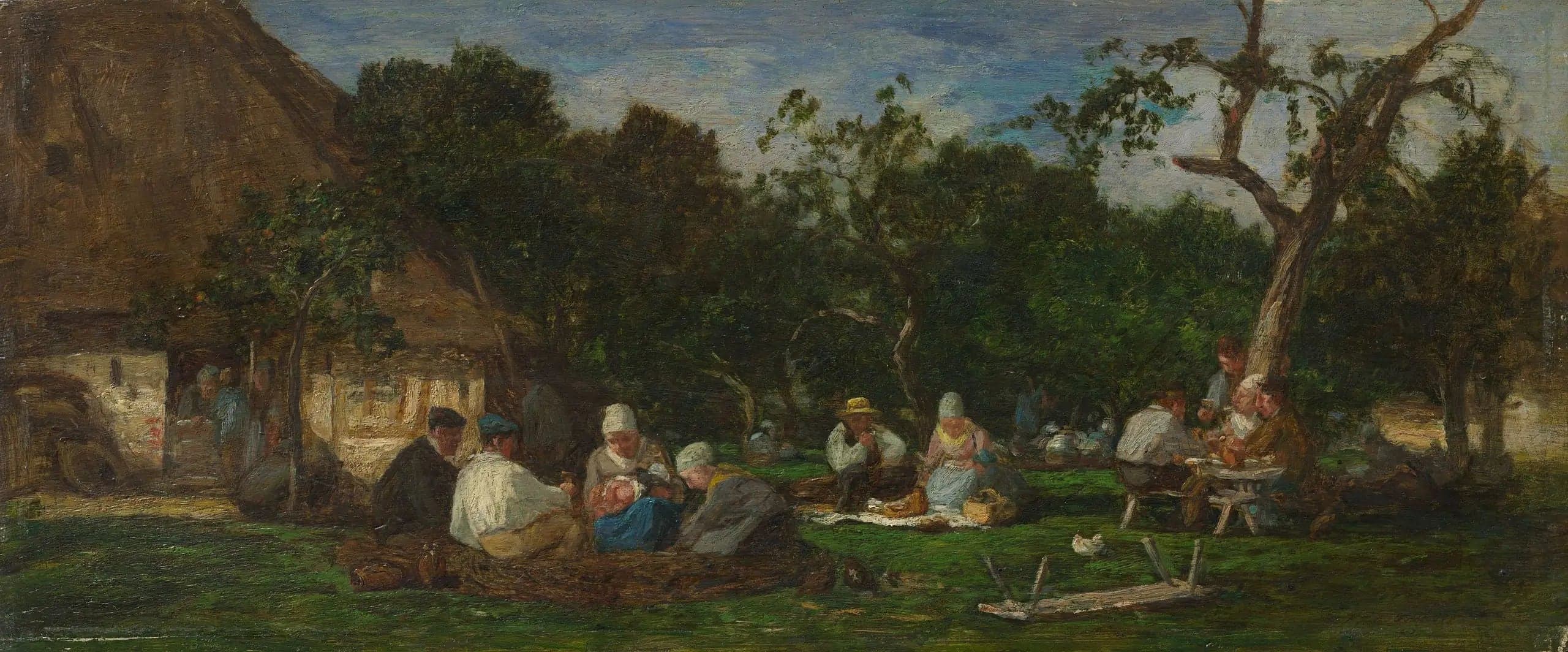
Honfleur: The Saint-Siméon Farm
- Original dimensions
- 40.5 x 17 cm
- Museum
- Barberini Museum
- Year
- 1855
Scene depicted
The painting “Honfleur: The Farm Saint-Siméon” unveils a poignant scene of rural life, where the farm, anchored in its lush environment, rises as a sanctuary of peace. The delicate hues and essence of the places transport us into a timeless universe, a frozen moment that tells the harmony between man and nature.
Historical context
This painting , created in 1855 in Honfleur, illustrates a significant moment of the impressionist movement that was emerging at the time. Honfleur, marked by its picturesque port in Normandy, was the ideal setting for this canvas where light dances with shadows, capturing the ephemeral beauty of nature. Currently exhibited at the Barberini Museum , this painting awakens the curiosity of art lovers around the world.
Place in the artist's career
This painting represents a crucial step in Boudin's career, marking the peak of a period when he mastered the technique of plein air. In parallel, works like “The Port of Trouville” and “Deauville Beach” show his artistic evolution towards increasingly bold compositions, rooted in the play of light and color.
Anecdote
“The orchestral light as I love it, it never lies, it sings with colors” could have said Boudin in front of his masterpiece , inspired by a gentle summer morning. Each brushstroke evokes the vibrant life of the places around the Farm Saint-Siméon, revealing an intimate connection between the artist and the beauty of the surrounding nature.
Major exhibitions
Impressionism: The Art of Landscape