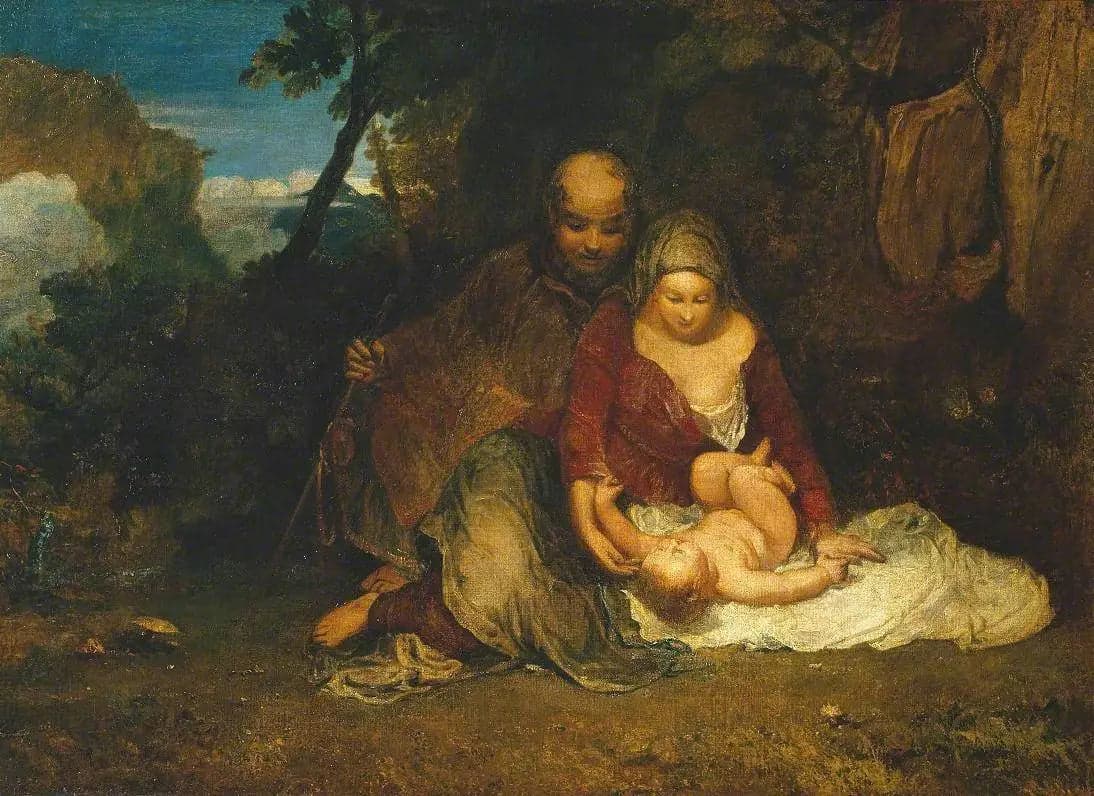
Holy Family
- Original dimensions
- 102.2 x 141.6 cm
- Museum
- Tate
- Year
- 1803
Scene depicted
At the heart of Holy Family , Turner immortalizes a moment of intimate tenderness. This canvas represents the Holy Family, enveloped in a soft and welcoming atmosphere. The warmth of the warm colors contrasts with the blue of the sky, symbolizing both a refuge and a leap towards the divine. The figures intertwine in a soothing silence, reminiscent of the sanctuary of family life.
Historical context
The painting titled Holy Family was created in 1803 and is part of the romantic movement, revolutionizing art at that time. Located in London, where the canvas currently resides, this pictorial work reflects a moment of transition in the history of art, combining realism and idealism. The dimensions of the painting already evoke Turner's ambition.
Place in the artist's career
Holy Family represents a turning point in Turner's career. Navigating between his promising beginnings and his stylistic peak, this painting is part of a period of maturity. Alongside masterpieces like The Last Voyage of the Temeraire and Rain, Steam and Speed , this pictorial work illustrates the evolution of his technique: increasingly bold and emotional.
Anecdote
Turner once stated: "Nature is the true master of art." This quote resonates deeply in the universe of Holy Family , where every luminous nuance transforms into a sweet melody, an ode to the fleeting beauty of life. It was a spring morning in 1803 when Turner, fascinated by the play of light, captured the wisdom of nature and familial love in this masterpiece .