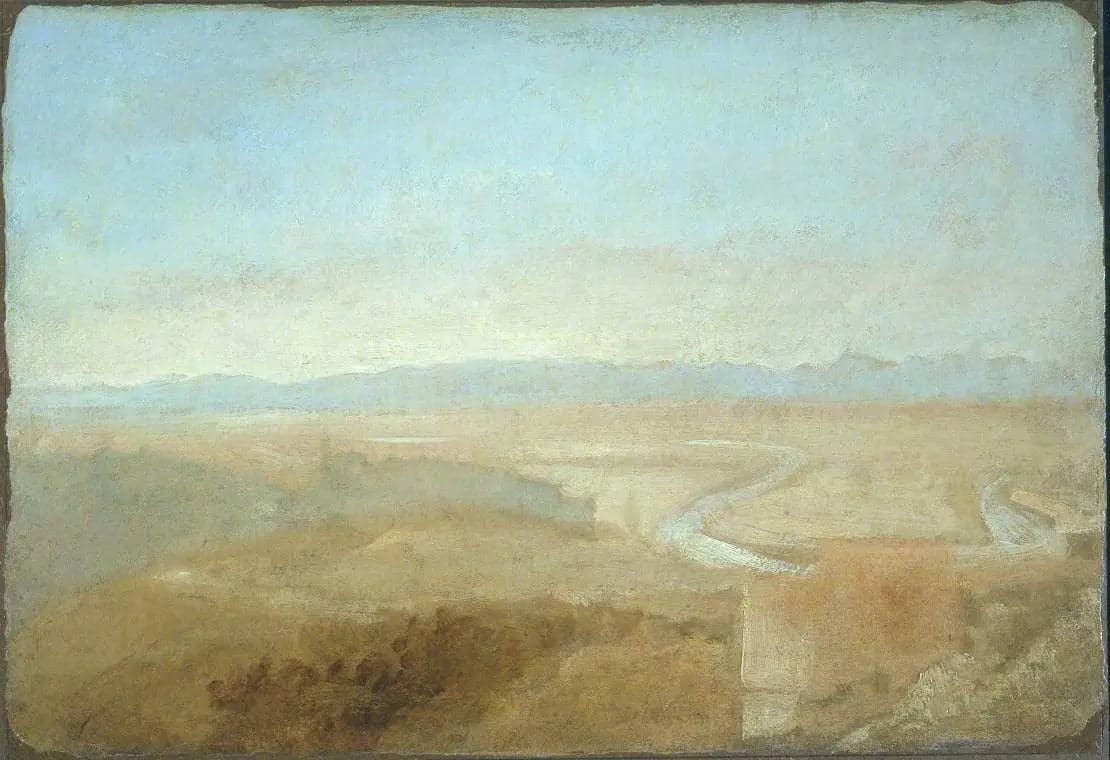
Hill Town on the Edge of the Campagna
- Original dimensions
- 41 x 59.4 cm
- Museum
- Tate
- Year
- 1828
Scene depicted
On this canvas , Turner transports us to the heart of a perched town, with its houses featuring outdated facades, delicately illuminated by the soft morning light. The surrounding hills flourish under a troubled sky, where clouds dance in a waltz of light and shadow. The meticulous composition invites the viewer to explore every detail, every nuance of the scene, while being captivated by the beauty and tranquility of the place.
Historical context
Created in 1828, this painting is emblematic of an era marked by a burgeoning romanticism , where light and texture become the main actors of an evocative canvas . Turner, whose studio was based in London, managed to capture all the magic of Italian landscapes, particularly the enchanting panorama of the Roman countryside. The painting is currently housed at the Tate , where it fascinates art lovers with its timeless beauty and contemplative dimension.
Place in the artist's career
The painting “Hill Town on the Edge of the Campagna” stands at the heart of Turner’s career, reflecting his major stylistic evolution. Once a master of landscape, he manages here to capture the very essence of light. In line with his other works, such as his famous “The Last Voyage of the Temeraire” and “Rain, Steam and Speed,” this masterpiece represents the pinnacle of his artistic maturity, where technique and emotion intertwine with finesse.
Anecdote
“Light is color, and color is my soul,” Turner might have said one morning, as he wandered through the streets of Rome. It is in this quest for clarity and sensation that he finds his inspiration for the masterpiece that is “Hill Town on the Edge of the Campagna.” The vibrant colors of dawn, the scent of wildflowers, and the song of birds all converged towards this canvas that transcends mere representation.