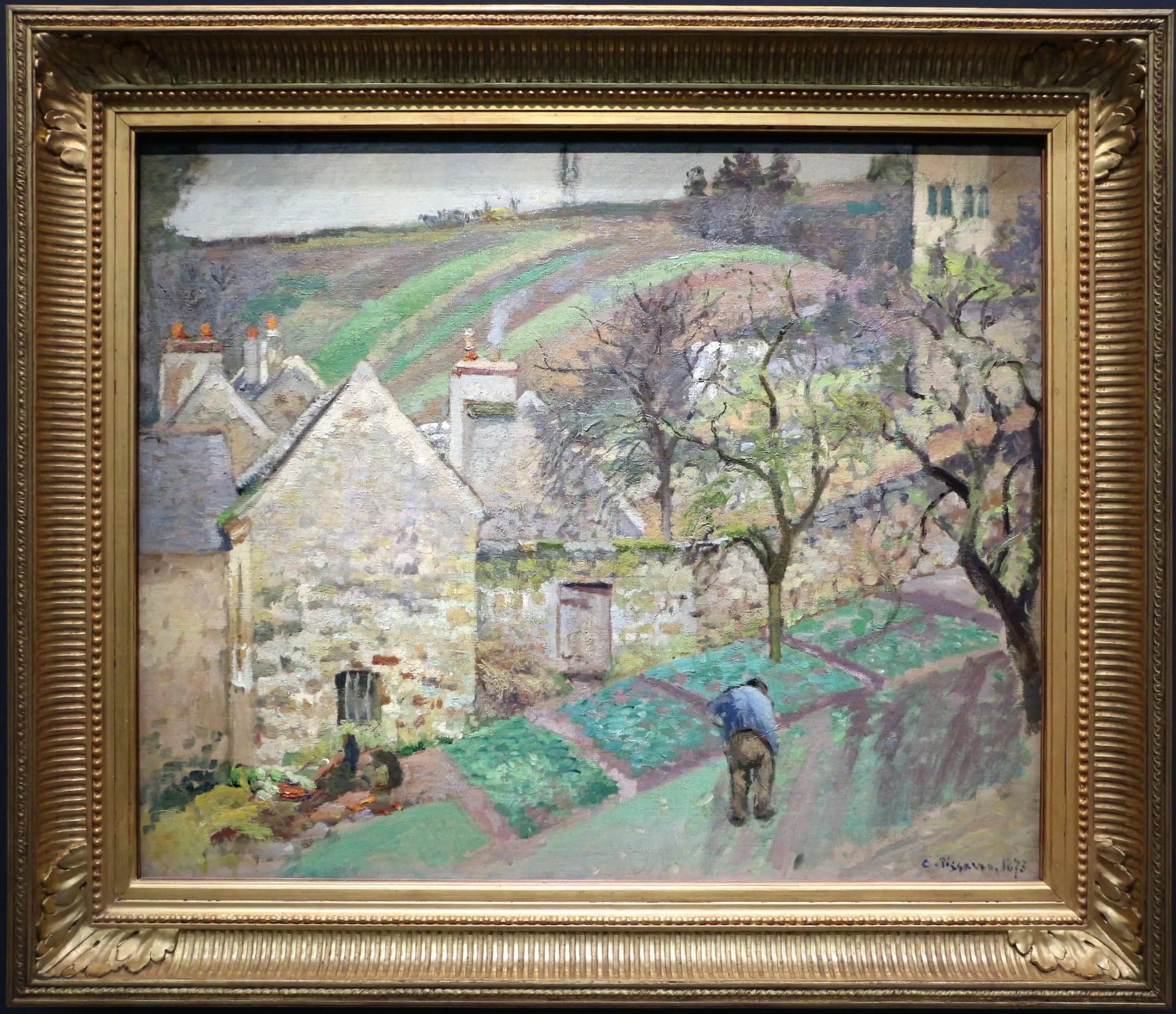
Hill of Hermitage, Pontoise
- Original dimensions
- 73 x 60 cm
- Museum
- musée d'Orsay
- Year
- 1873
Scene depicted
In this painting , the lush hills of the Hermitage rise majestically, while shadows dance with light on the winding paths. Pissarro captures the bucolic beauty of this landscape, celebrating the harmonies of nature. The leaves of the trees vibrate, as if to the sound of a soft and subtle melody, while the sky, tinted with golden and azure hues, seems intimately linked to the movements of the earth.
Historical context
Created in 1873, in the heart of Pontoise, this painting is emblematic of the Impressionist movement, a revolutionary artistic current that profoundly redefined the norms of pictorial representation. At that time, Pissarro, a fervent advocate of light and nature, kindly gazes upon the landscapes that surround him, elevating these ordinary scenes to the status of works of art. Currently, the canvas proudly rests at the musée d'Orsay in Paris, where its voluptuous dimensions of 73 x 60 cm captivate visitors with their timeless beauty.
Place in the artist's career
Coteau de l'Hermitage reveals itself as a major milestone in Pissarro's career. This painting represents a stylistic maturation, a turning point towards explosions of light and the authentic representation of landscapes. At the heart of his career, one can also appreciate works such as “The Floor Scrapers” and “Boulevard Montmartre, Spring,” which testify to the constant evolution of his artistic approach.
Anecdote
“Nature inspires me and I pay homage to it through my canvas,” Pissarro might have declared one fresh morning by the Oise. The gentle glow of the spring sun, the whispers of the leaves in the breeze, and the glimmers of the first rays were all elements that had inspired him towards this masterpiece . His inspiration is palpable in Coteau de l'Hermitage , where each brushstroke evokes the delicate tremor of life.