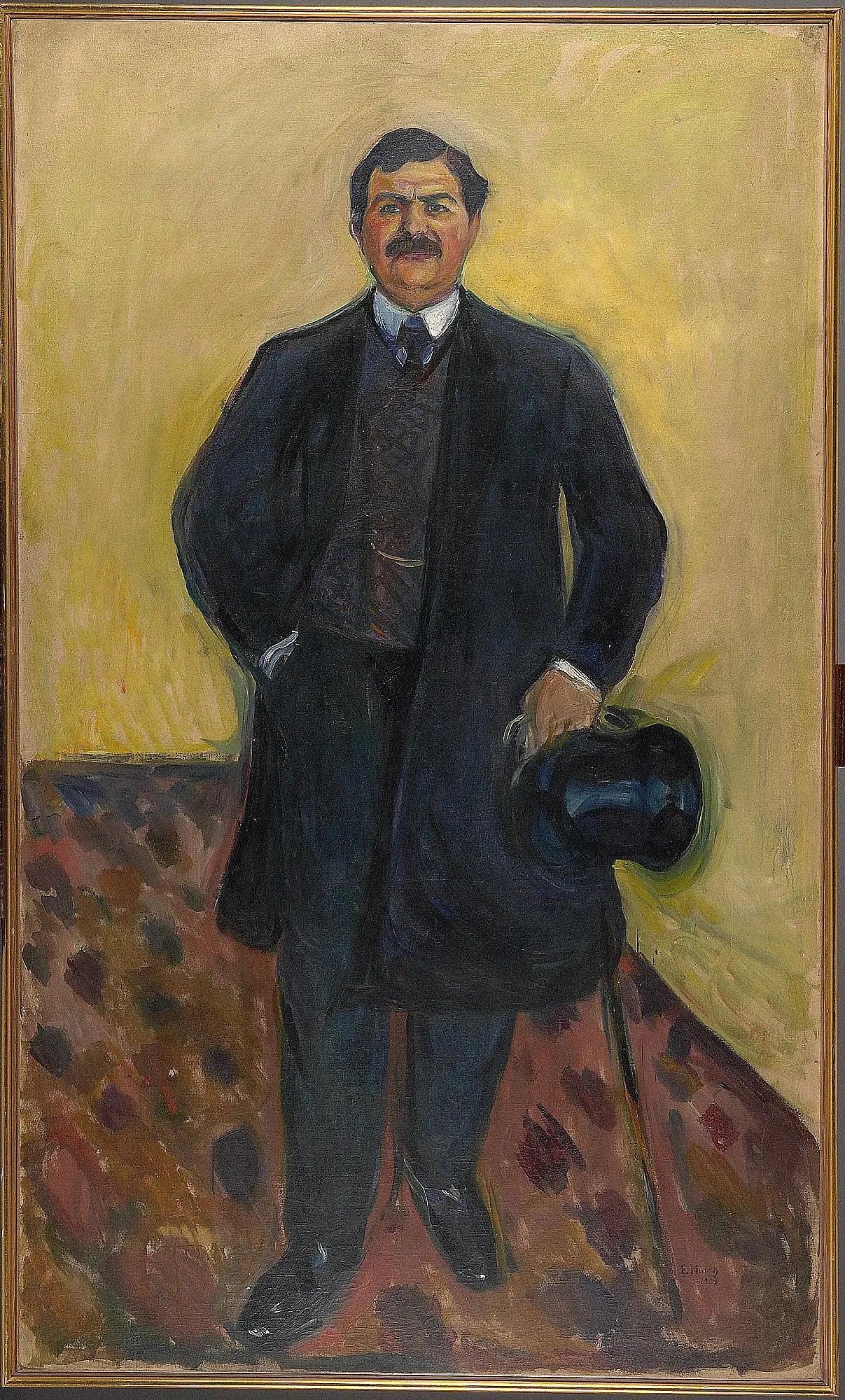
Hermann Schlittgen
- Original dimensions
- 120 x 200 cm
- Museum
- Munch Museum
- Year
- 1904
Scene depicted
In this composition , Munch takes us to the heart of the inner turmoil of man through the portrait of Hermann Schlittgen. Each brushstroke expresses him beyond the visible, revealing raw emotions and buried thoughts. The canvas becomes a mirror of the soul, summarizing human anxieties and passions, and inscribing its author in the history of the arts.
Historical context
The iconic painting , created in 1904 and displayed at the Munch Museum in Oslo, illustrates the emotional burden of the expressionist movement. In a time when anxiety and melancholy dominated minds, this canvas stands as a testament to the human soul, oscillating between light and darkness.
Place in the artist's career
This painting asserts itself as one of the pillars of Munch's career, marking a continuity in his quest for expression. It fits into a rich journey, alongside works such as “The Scream” and “The Madonna,” revealing his innovative style that transfigures human pain into a vibrant and poignant painting .
Anecdote
“Art must always be intimate,” said Munch, evoking the inspiration that drove him to bring this masterpiece to life. Imagine him, one spring morning, wandering the streets of Berlin, captivated by the light that caresses faces, a fleeting encounter that imprints on his mind and shapes this painting .
Major exhibitions
Edvard Munch : portraits