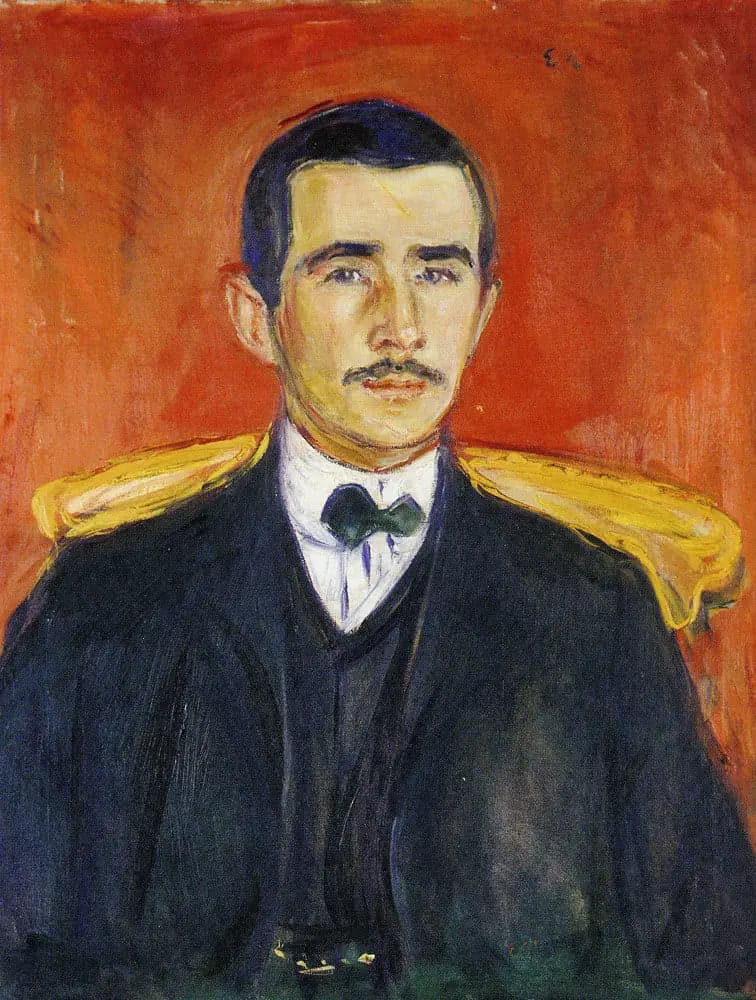
Herbert Esche
- Original dimensions
- 55.5 x 71 cm
- Museum
- Kunsthaus Zurich
- Year
- 1905
Scene depicted
The scene of "Herbert Esche" depicts a captivating portrait, revealing intense psychological depth. Munch explores not only the physical traits but also the soul of the character, creating a vibrant visual echo that directly engages the viewer. The interplay of light and shadow evokes varied feelings, from melancholy to introspection.
Historical context
Created in 1905 in Oslo, the painting "Herbert Esche" is part of the expressionist movement, marking a time of profound emotional and social upheaval. Known for its intensity, this timeless canvas is preserved at the Kunsthaus Zurich , a sanctuary for admirers of Munch's works. The dimensions of this painting , 55.5 x 71 cm, invite close contemplation, revealing the nuances of an art in full mastery.
Place in the artist's career
This painting marks a turning point in Munch's career, inscribing his distinctive style within expressionism . It positions itself at a pivotal moment, between iconic works such as "The Madonna" and "The Scream," testifying to the evolution of his technical and emotional approach. The exploration of portraits reveals itself as an essential dimension of his artistic legacy.
Anecdote
"Art is a declaration of love, a deep and ballet in the corbel of the soul." In an alley in Paris, one spring morning, Munch absorbed the spirit of his city, hearing whispers of inspiration that brought this masterpiece to life. This painting is the result of a fleeting moment, imbued with emotions, crystallizing in every brushstroke.
Major exhibitions
Edvard Munch : portretter