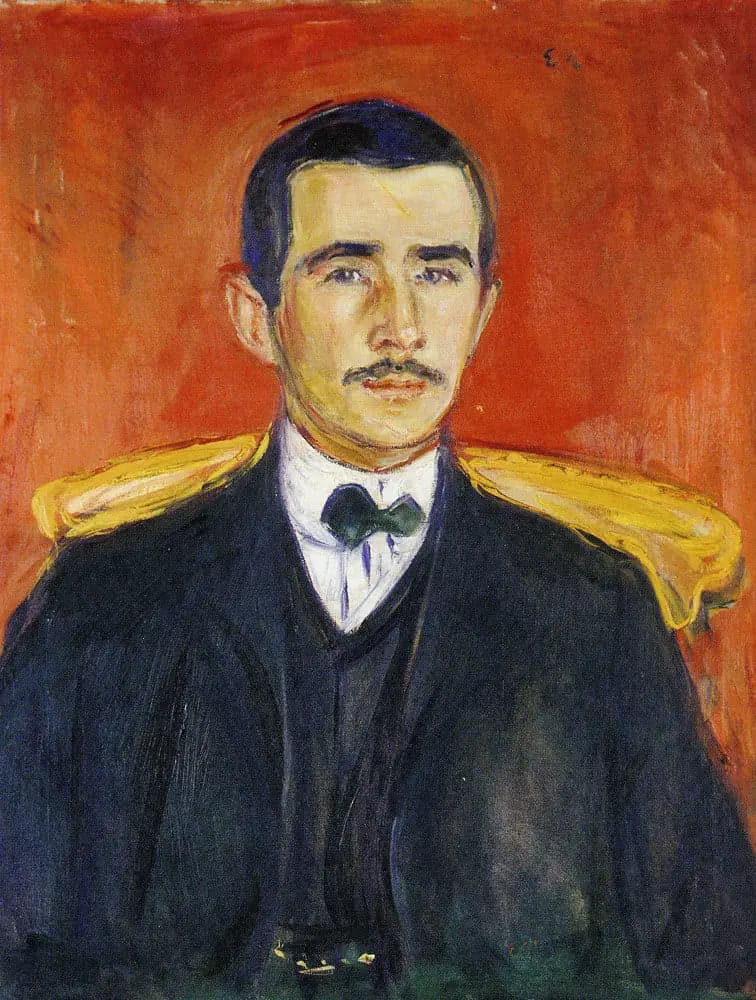
Herbert Esche
- Original dimensions
- 70 x 120 cm
- Museum
- Kunsthaus Zurich
- Year
- 1905
Scene depicted
"Herbert Esche" captures a scene imbued with tranquility. The composition highlights the subtle relationship between man and his environment, a silent dialogue where each element, from the trees dancing in the wind to the fleeting reflection of a face, contributes to a visual narrative where solitude and beauty coexist. The viewer is invited to feel this intimate connection, like a secret passage to the human soul.
Historical context
Created in 1905 in Oslo, in the heart of Norway, the painting "Herbert Esche" is part of the expressionist movement, characteristic of Munch's tumultuous period. Immersed in an atmosphere filled with emotion and melancholy, this emblematic work is a masterpiece that holds a fundamental place in the Kunsthaus Zurich , where it continues to amaze visitors with its depth and vibrancy. Its dimensions, 70 x 120 cm, contribute to its powerful visual impact.
Place in the artist's career
This painting represents a turning point in Munch's career, marking a period of effervescent creativity. At this time, he explores his personal vision in a series of paintings such as "The Scream" and "The Madonna," each work echoing intense emotions, illustrating his technical and stylistic evolution. "Herbert Esche" stands at a crossroads, a milestone in his artistic quest for the expression of turmoil and the joy of living.
Anecdote
"Every painting is a scream, a deep exclamation of the soul," said Munch. This echo resonates particularly in the canvas "Herbert Esche." One foggy morning, the painter was walking through an alley in Oslo, observing the soft light playing with the shadows. This fleeting moment, filled with gentle melancholy, inspired the emotional intensity of his masterpiece .