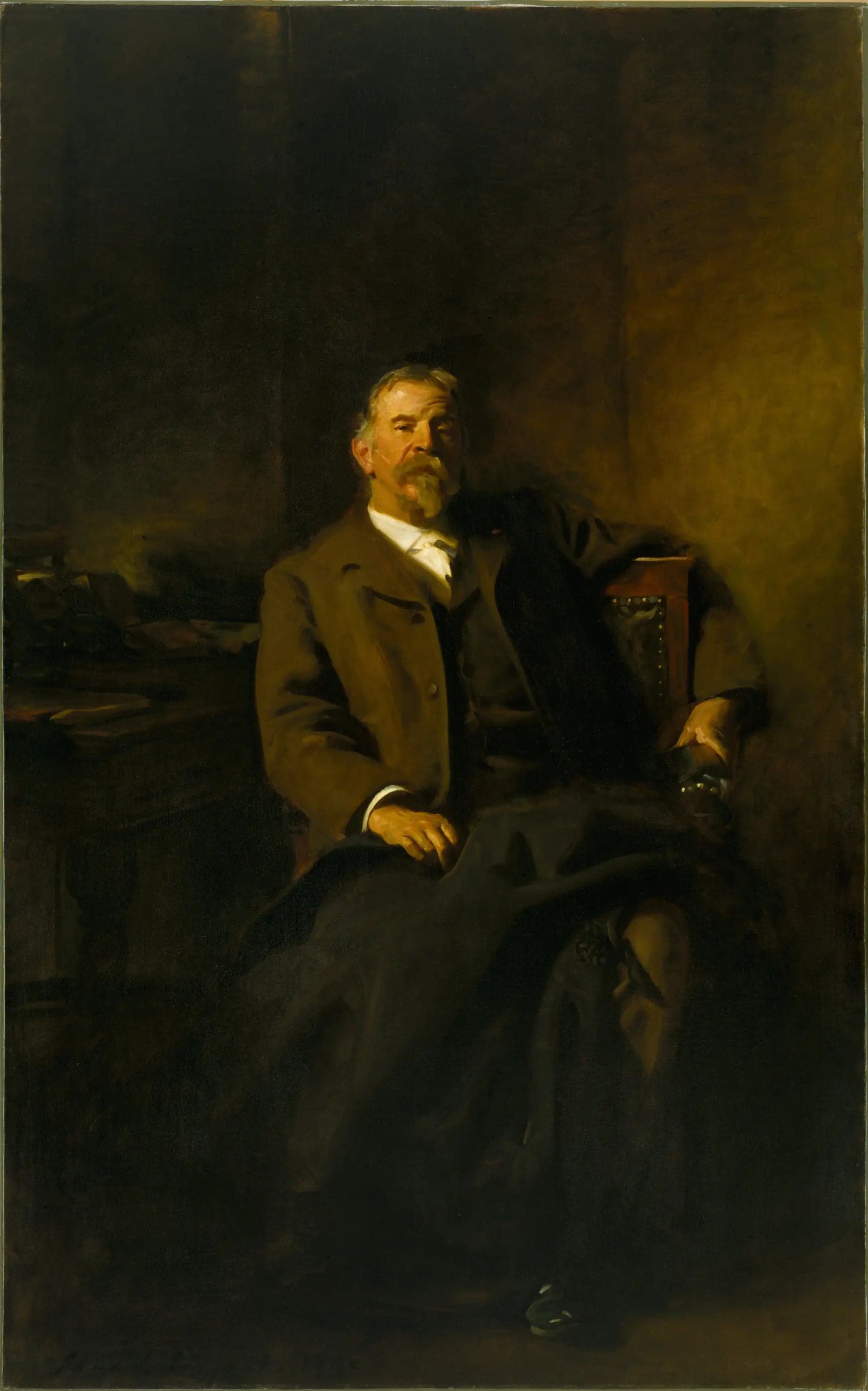
Henry Lee Higginson
- Original dimensions
- 153.7 x 246.1 cm
- Museum
- Fogg Art Museum
- Year
- 1903
Scene depicted
The painting "Henry Lee Higginson" is a captivating portrait of the American philanthropist and patron of the arts. Sargent's subtle composition reveals not only Higginson's personality but also his influence on the artistic world of his time. The canvas depicts a man with a serious face, his piercing eyes reflecting his intellectual depth and passion for art, all wrapped in an atmosphere of solemn elegance.
Historical context
Created in the early 20th century, in 1903, this painting is emblematic of the artistic movement of realism and portraiture. John Singer Sargent , known for his mastery of portraiture, conceived this work in Cambridge, Massachusetts, where the Fogg Art Museum proudly preserves its history. This canvas , measuring 153.7 x 246.1 cm, is a postcard of elegance and the era of American fine arts, showcasing Sargent's talent.
Place in the artist's career
This painting represents an important milestone in the career of John Singer Sargent , marking a stylistic peak in his mastery of portraiture. It can be compared to other works such as "Madame X" and "El Jaleo," where one observes an evolution in his approach to light and movement, as well as an increasing emotional depth. With each canvas , Sargent weaves a unique and vibrant narrative.
Anecdote
Sargent, a master of light and shadow, once said: "Painting is the art of illusion. It is about making viewers believe they are observing the truth itself." This quote resonates with the genesis of the masterpiece , which came to life on a sunny morning in the heart of New England. In a soothing environment, he was inspired by the depth of gazes, which can be found in the painting .