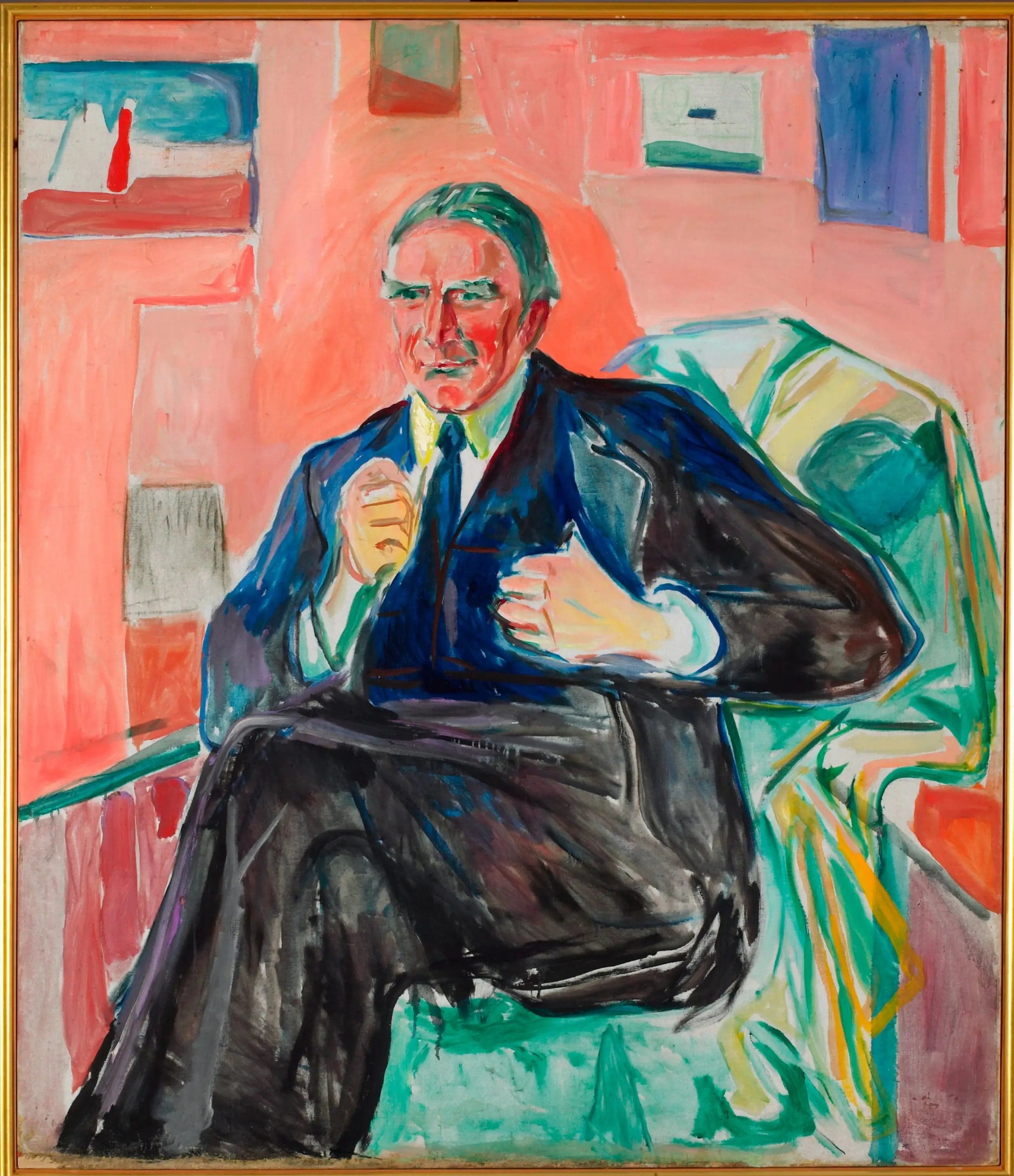
Henrik Bull
- Original dimensions
- 120 x 140 cm
- Museum
- Munch Museum
- Year
- 1939
Scene depicted
The painting “Henrik Bull” presents a captivating portrait of a man with a thoughtful gaze, immersed in his reflections. The composition succeeds in capturing the essence of the individual while evoking universal feelings of melancholy and serenity, typical of Edvard Munch 's work. Each brushstroke seems to tell a rich inner story, inviting the viewer to deep introspection.
Historical context
Created in 1939, the canvas Henrik Bull is part of the symbolism movement that characterizes the work of Edvard Munch , a Norwegian artist deeply influenced by human emotions. This painting , located at the Munch Museum in Oslo, reflects a time marked by sociopolitical upheavals and an introspective quest for identity and meaning.
Place in the artist's career
“Henrik Bull” represents an important phase in Edvard Munch 's career, illustrating the stylistic mastery he developed over the years. When compared to other paintings such as “The Scream” and “The Madonna,” one observes an evolution in the expression of human emotions, using vibrant colors and expressive gestures to enhance the connection between the artist and his audience.
Anecdote
“Art must be a sincere confession of the soul.” This quote from Edvard Munch resonates particularly during the creation of this masterpiece , which he composed on a bright April morning, contemplating life in its deepest nuances. His attentive gaze at the details of a face encountered in a silent street nourished the vibrant emotion of the painting .
Major exhibitions
Edvard Munch : portraits