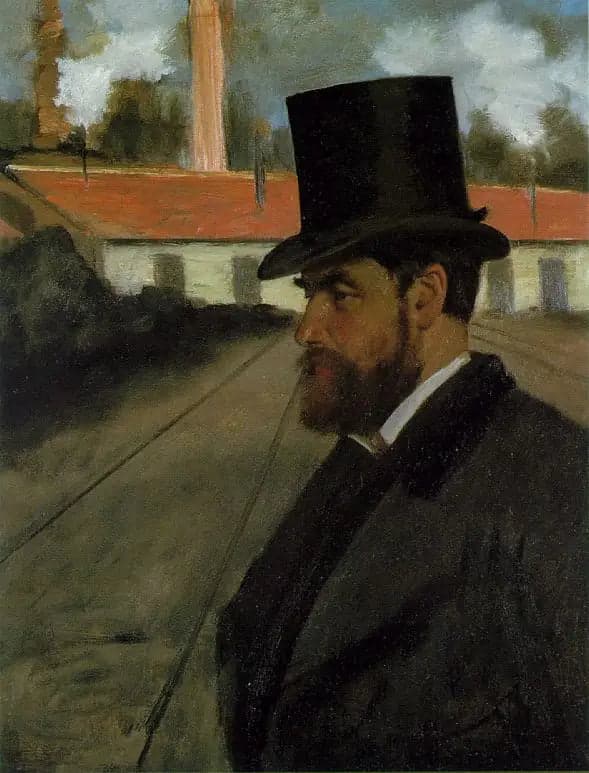
Henri Rouart in front of his factory
- Original dimensions
- 50.48 x 65.41 cm
- Museum
- Carnegie Museum of Art
- Year
- 1875
Scene depicted
In this painting , we discover Henri Rouart, pale and thoughtful, standing in front of his factory. The contrast between the individual and the industrial structure behind him illustrates the complex relationship between man and machine, a dialogue at the heart of the Industrial Revolution. The composition highlights not only Rouart's identity but also the changing landscape of Paris, imbued with palpable tension.
Historical context
Created in 1875 in Paris, this painting is rooted in the impressionist movement, which seeks to capture the fleeting impressions of everyday life. The canvas , currently exhibited at the Carnegie Museum of Art , echoes a time when industrialization was transforming the urban landscape. The dimensions of the masterpiece reveal Degas's mastery, highlighting his immersive approach and refined compositions.
Place in the artist's career
This canvas stands as a milestone in Degas's career, marking a stylistic evolution towards bolder compositions. At this time, he mingled with other artists such as Monet and Renoir, but with a unique approach to light and human figures. Compared to his works, such as “The Dance Class” and “The Absentees,” this masterpiece reveals a more introspective view of the industrial legacy.
Anecdote
Edgar Degas , in an intimate conversation, reportedly stated: “Art is not what you see, but what you make others see.” This masterpiece was inspired by a misty morning, where the daylight slowly revealed the contours of the factory, animating the scene with a vibrant and unique atmosphere. This canvas captures not only a moment but a powerful emotion related to the transformation of his time.
Major exhibitions
third impressionist exhibition