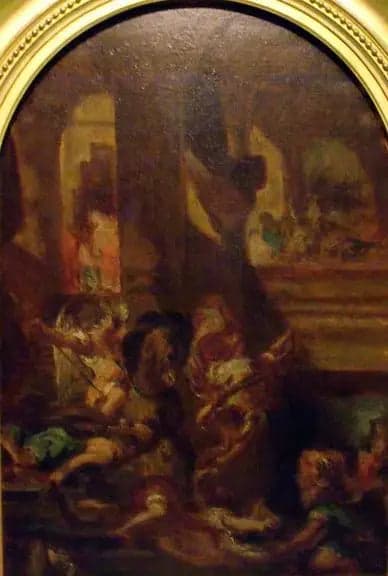
Heliodorus Driven from the Temple
- Original dimensions
- 40.5 x 57 cm
- Museum
- National Museum
- Year
- 1850
Scene depicted
The painting depicts a dramatic moment, where the priest Heliodore, representing profane forces, is driven from the temple by divine forces. This thrilling confrontation between the sacred and the profane unfolds in majestic architecture, bathed in light, highlighting the rivalry between faith and criminality. Each character is charged with dramatic intensity, and the light, like a gentle caress, enhances the whole.
Historical context
Created in 1850, this painting is one of the most significant works of Eugène Delacroix , a master of Romanticism , who captured the human soul with ardor and depth. This famous canvas , currently housed in the National Museum, immerses the viewer in an atmosphere filled with dramatic tension, silhouetted against the deep blue sky of the time.
Place in the artist's career
This painting marks a turning point in Delacroix's career, illustrating both the peak of his Romantic style and the evolution of his artistic expression. Alongside other iconic paintings such as Liberty Leading the People and The Death of Sardanapalus , Heliodore Driven from the Temple emphasizes a growing mastery of color and composition that distinguishes him in the artistic landscape of the 19th century.
Anecdote
“Art must capture the very essence of the soul,” Delacroix reportedly said one spring morning as he observed the play of light through the branches of a tree. This quote resonates deeply with the evocative power of his masterpiece , Heliodore Driven from the Temple, where each brushstroke tells a story of palpable emotion and spirituality.