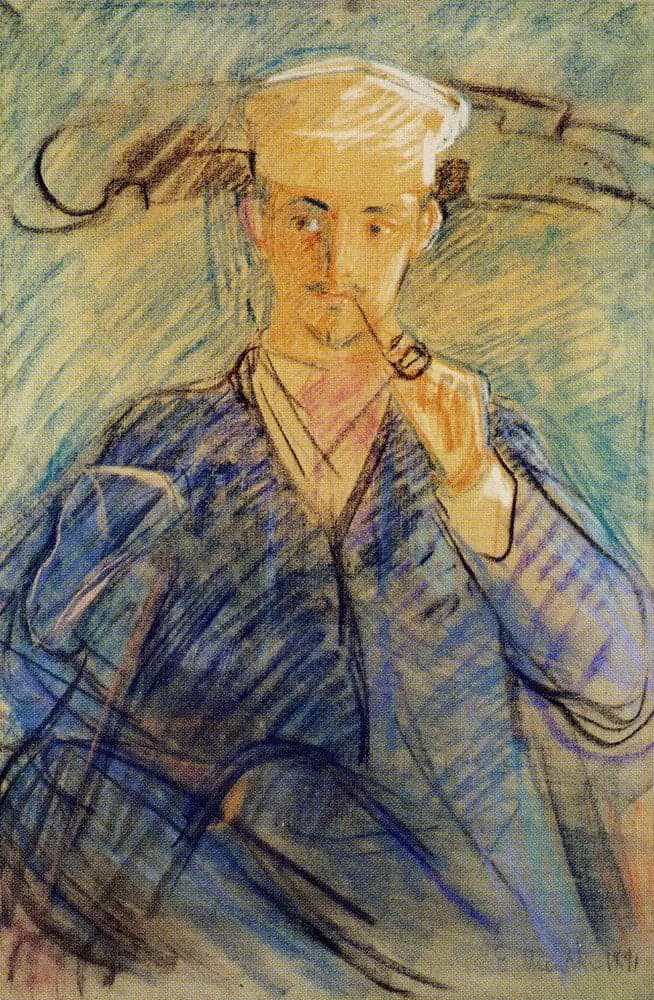
Helge Rode
- Original dimensions
- 41.5 x 49 cm
- Museum
- Munch Museum
- Year
- 1908
Scene depicted
The painting Helge Rode illuminates a poignant portrait of a man whose gaze, intense and thoughtful, seems to embrace the complexity of human emotions. Munch, with his delicate touch and waking dream, brings to life a composition that invites reflection. The scene immerses us in a fascinating surge of introspection, where each element of the artwork tells a particular story, harmonizing the main subject with a background suggesting mystery and hidden depth.
Historical context
Created in 1908, the canvas Helge Rode is part of the Expressionist movement that originated in Oslo, a city of a thousand facets, the cultural epicenter of the early 20th century. This tumultuous period saw the emergence of raw emotions and deep explorations of the human soul. The painting is housed in the Munch Museum, a sanctuary dedicated to the art of this master, where it continues to move visitors from around the world.
Place in the artist's career
Helge Rode holds a special place in Munch's journey, reflecting a period marked by his stylistic maturation. In parallel with The Scream, one of his most famous paintings , and The Madonna, it establishes a dialogue on pain and beauty, marking milestones of an aesthetic that is as personal as it is revolutionary in the realm of visual arts.
Anecdote
Munch often spoke of the importance of emotions in his works. "I paint my own dreams and my own nightmares," he said. This is exactly what he achieved when creating this masterpiece , one fresh morning, when the light of a Scandinavian spring caressed the human forms depicted on this canvas . The fusion of a peaceful atmosphere and inner turmoil resonates through the palpable intensity of this painting .
Major exhibitions
Edvard Munch : portraits