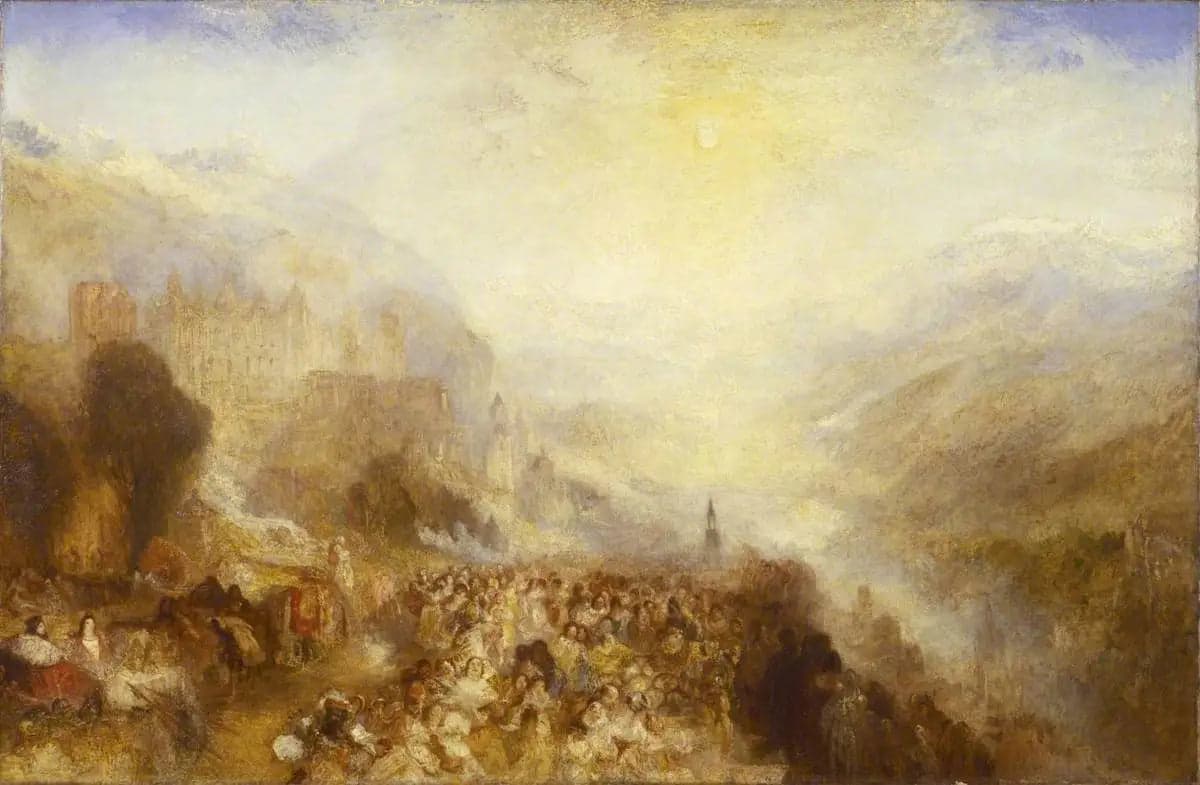
Heidelberg
- Original dimensions
- 132.1 x 201.9 cm
- Museum
- Tate
- Year
- 1844
Scene depicted
The painting “Heidelberg” reveals a captivating snapshot of the city, where the majestic castle seems to emerge from the morning mists, like an embrace of mystery. The Neckar River flows peacefully, while the surrounding mountains add a romantic dimension to this scene. This pictorial work brilliantly illustrates the fusion between architecture and nature, testifying to the harmony between man and his environment.
Historical context
Created in 1844, this remarkable painting immerses us in the romantic atmosphere of Heidelberg, a German city located on the banks of the Neckar River. Turner, an iconic figure of the romantic movement, captures the timeless beauty of the landscape cherished in the pre-industrial era. Currently exhibited at the Tate , this painting of impressive dimensions (132.1 x 201.9 cm) is a true invitation to contemplation.
Place in the artist's career
This painting represents a pivotal moment in Turner's career, situated in his period of artistic maturity. Alongside other great works such as “The Wheat Field with Crows” and “The Deluge,” “Heidelberg” reflects an evolution in exploring the effects of light and nuanced atmospheres.
Anecdote
Joseph Mallord William Turner pushed the boundaries of pictorial art with these words: “Light is the color of melody.” Inspired on a gentle sunny morning, he was enchanted by the shimmering reflections of the sun on the old stones of Heidelberg. This original emotion resonates powerfully in the composition of this masterpiece, vibrating the soul of the canvas.