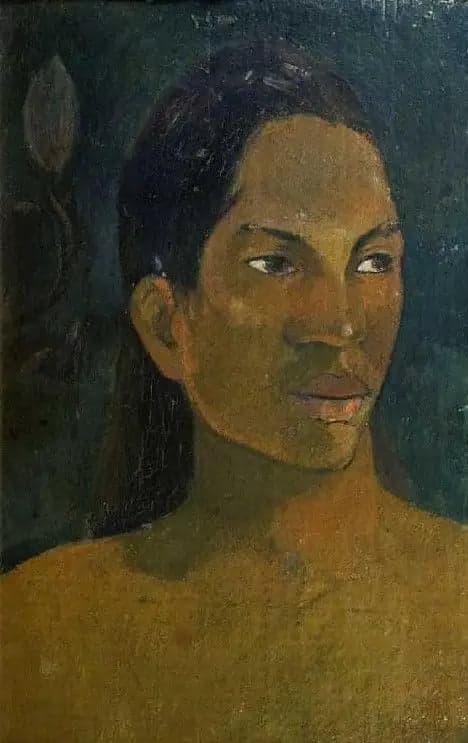
Head of Tahitian Woman
- Original dimensions
- 27 x 41 cm
- Museum
- Not specified
- Year
- 1982
Scene depicted
In "Tête de Tahitienne", the artist depicts the face of a woman with an introspective gaze, enhanced by warm colors and soft shapes. This composition reveals the simplicity and complexity of Tahitian beauty, inviting the viewer to reflect on identity and culture through the features of its model. It testifies to the deep bond that Gauguin was able to establish with this distant land and its inhabitants.
Historical context
Created in 1982, the painting "Tête de Tahitienne" is part of the post-impressionist movement that emerged at the end of the 19th century. Paul Gauguin , this visionary artist, captured the essence of the exotic landscapes of Tahiti, enriching his work with vibrant sensuality. Geographically speaking, it is an emblematic piece of Western art, although its current location remains unspecified, adding a mystery to its legacy. The canvas unfolds its dimensions of 27 x 41 cm, an intimate size that invites contemplation.
Place in the artist's career
This painting , "Tête de Tahitienne", marks a turning point in Gauguin's career, propelling it to the peak of his art. In parallel, one can mention "Vision after the sermon" and "The Coffee Trees" which, although they reflect different initial styles, resonate with the same message of transcendence and the search for authenticity. This painting truly embodies his period of maturity, where he combines technique and emotion.
Anecdote
“I sought beauty where the soul is nourished, in the eyes of my models,” Gauguin might have declared during the creation of this canvas . This painting was born from a burning inspiration, one bright morning in the heart of the island, where he crossed paths with the striking gaze of a Tahitian woman. This chance encounter awakened a deep emotion within him, revealing a masterpiece with delicate nuances.