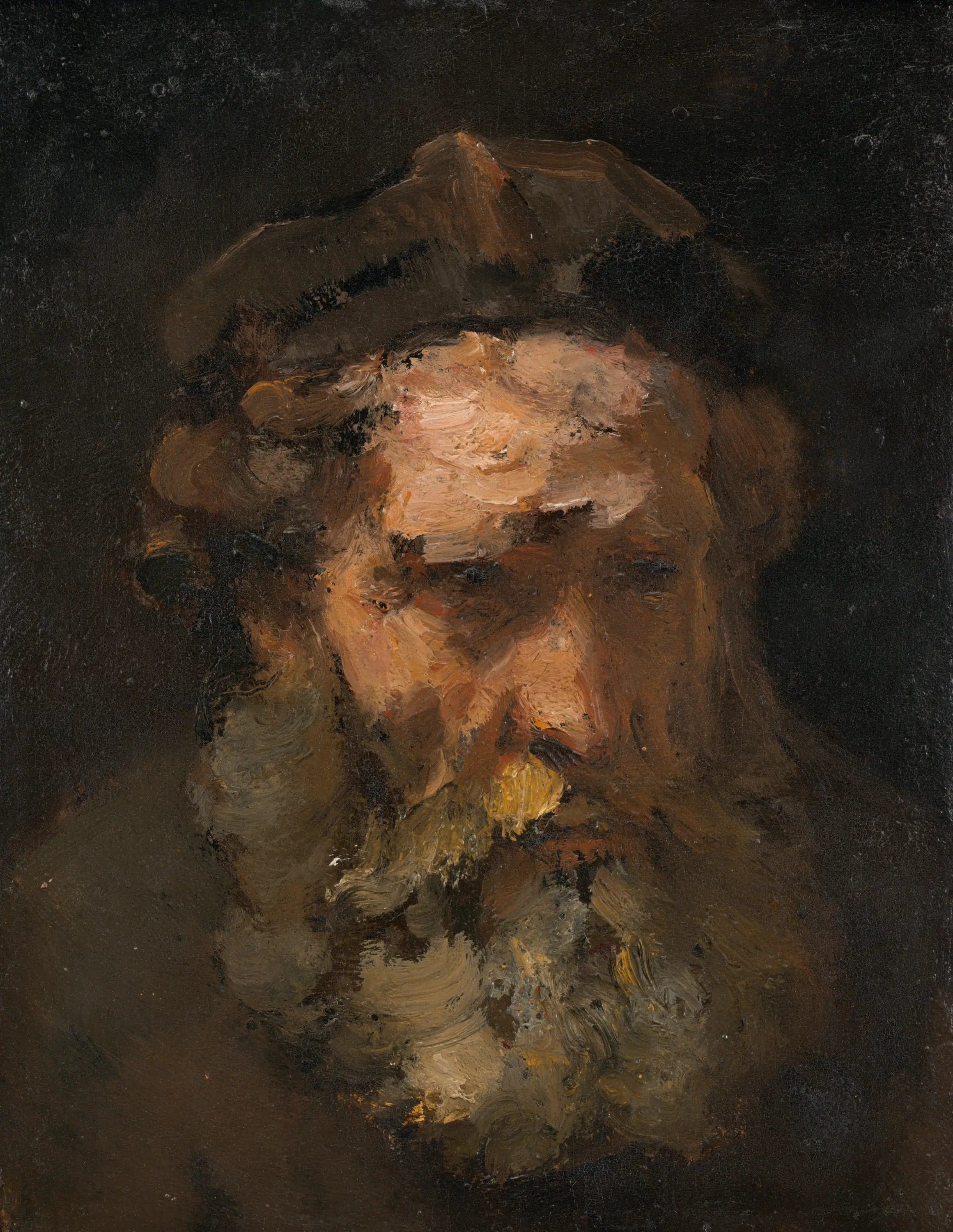
Head of Saint Matthew
- Original dimensions
- 19.5 x 25 cm
- Museum
- National Gallery of Art
- Year
- 1662
Scene depicted
The painting “Tête de Saint Matthieu” presents the intense moment when the saint, surrounded by light and shadow, is immersed in deep reflection. The expression on his face, both serious and serene, tells a story that transcends the frame of the painting . Rembrandt manages to capture the essence of a life marked by faith, commitment, and contemplation.
Historical context
Created in 1662, this magnificent painting took shape in Amsterdam, the capital of the United Provinces, a cradle of commercial and artistic wealth of the time. In a moment of effervescent creativity, Rembrandt , master of chiaroscuro, created this iconic work, belonging to the baroque movement. Today, this painting resides at the National Gallery of Art , a sanctuary for art lovers, where it is scrutinized with admiration. Its elegant dimensions, 19.5 x 25 cm, draw the eye to the subtleties of each brushstroke.
Place in the artist's career
This painting is part of the mature period of Rembrandt , when he had already conquered the world with works such as “The Night Watch” and “The Anatomy Lesson of Dr. Tulp.” “Tête de Saint Matthieu” embodies an evolution in his technique, moving from a dynamic composition to a more introspective representation, reflecting his growing mastery of chiaroscuro.
Anecdote
“Light is the breath of art,” Rembrandt is said to have remarked while reflecting on his work on this piece. Imagine a spring morning, the first rays of sunlight filtering through a window, illuminating the face of a thoughtful man. It is in this moment that the artist was able to capture the very essence of the canvas , evoking the strength and vulnerability of Saint Matthew.