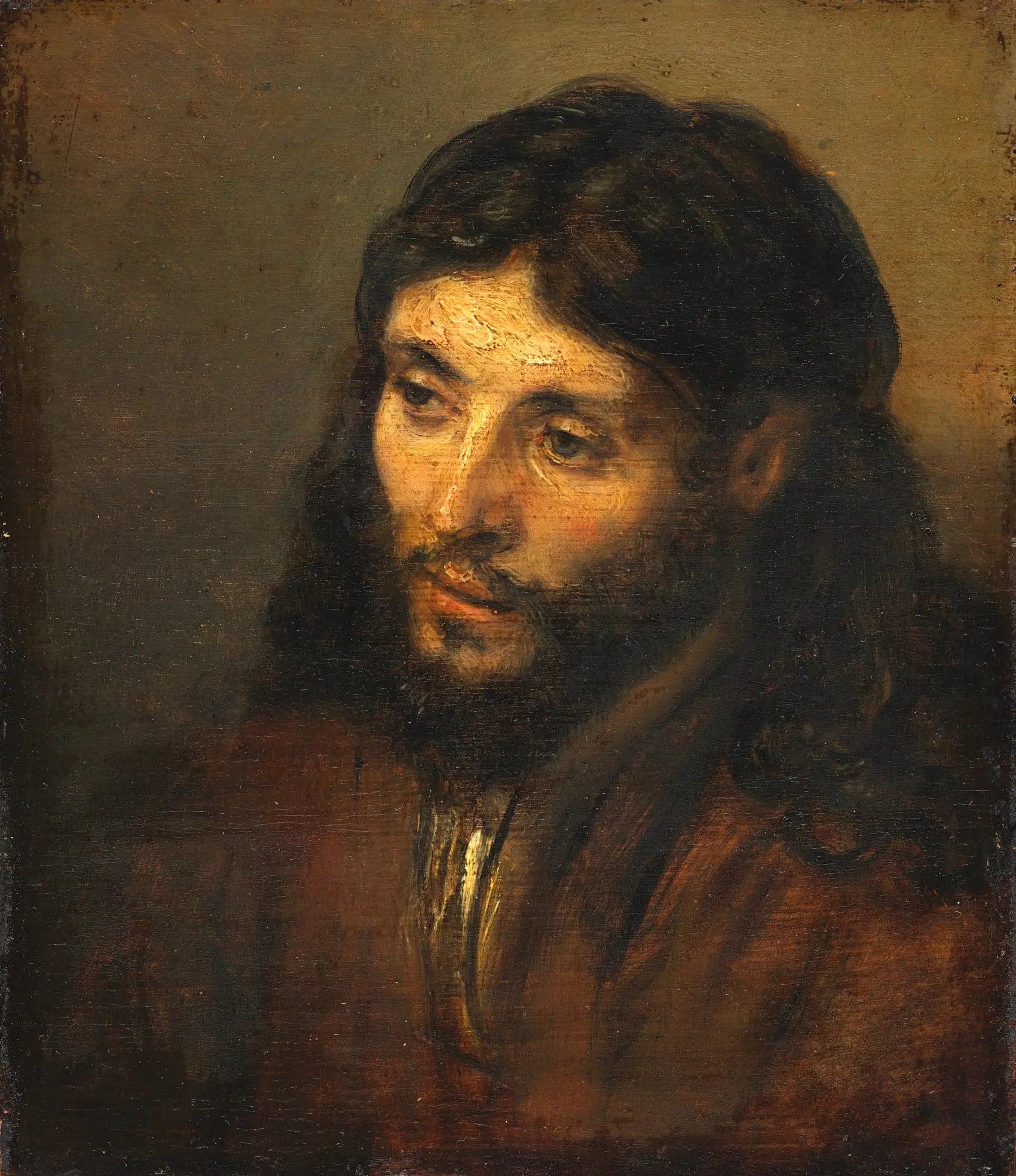
Head of Christ
- Original dimensions
- 21.7 x 25 cm
- Movement
- Dutch Golden Age
- Museum
- Gemäldegalerie
- Year
- 1647
Scene depicted
The painting “Tête du Christ” presents a face imbued with transcendental serenity. From the deep blue of the shadows to the soft glow of light on the skin, each element magnifies the spirituality of the image. The gaze of Christ seems to contemplate you, conveying a profound inner peace, like an invitation to personal contemplation.
Historical context
Created in 1647, this painting executed in Amsterdam, the iconic city of the 17th century, evokes the Dutch Golden Age of painting. In a context of artistic prosperity, where light and interior came to life on the canvas, the painting is today exhibited at the Gemäldegalerie, a sanctuary for art treasures. With delicate dimensions of 21.7 by 25 cm, this pictorial work combines intimacy and depth.
Place in the artist's career
This painting occupies a central place in the artistic evolution of Rembrandt . It is a stylistic peak, illustrating his mastery in the art of chiaroscuro. Compared to his famous “Night Watch” and “The Anatomy Lesson of Dr. Tulp,” one perceives an increased maturity, a refinement of emotions, and a technical mastery that define the pinnacle of his work.
Anecdote
“Light is the master of shadow,” could have declared Rembrandt while painting this work. Imagine a spring morning, the sun's rays filtering through the velvet curtains of a studio, where silence invites meditation. This fleeting moment inspires every brushstroke on the painting , revealing the soul of Christ in a caressing golden light.