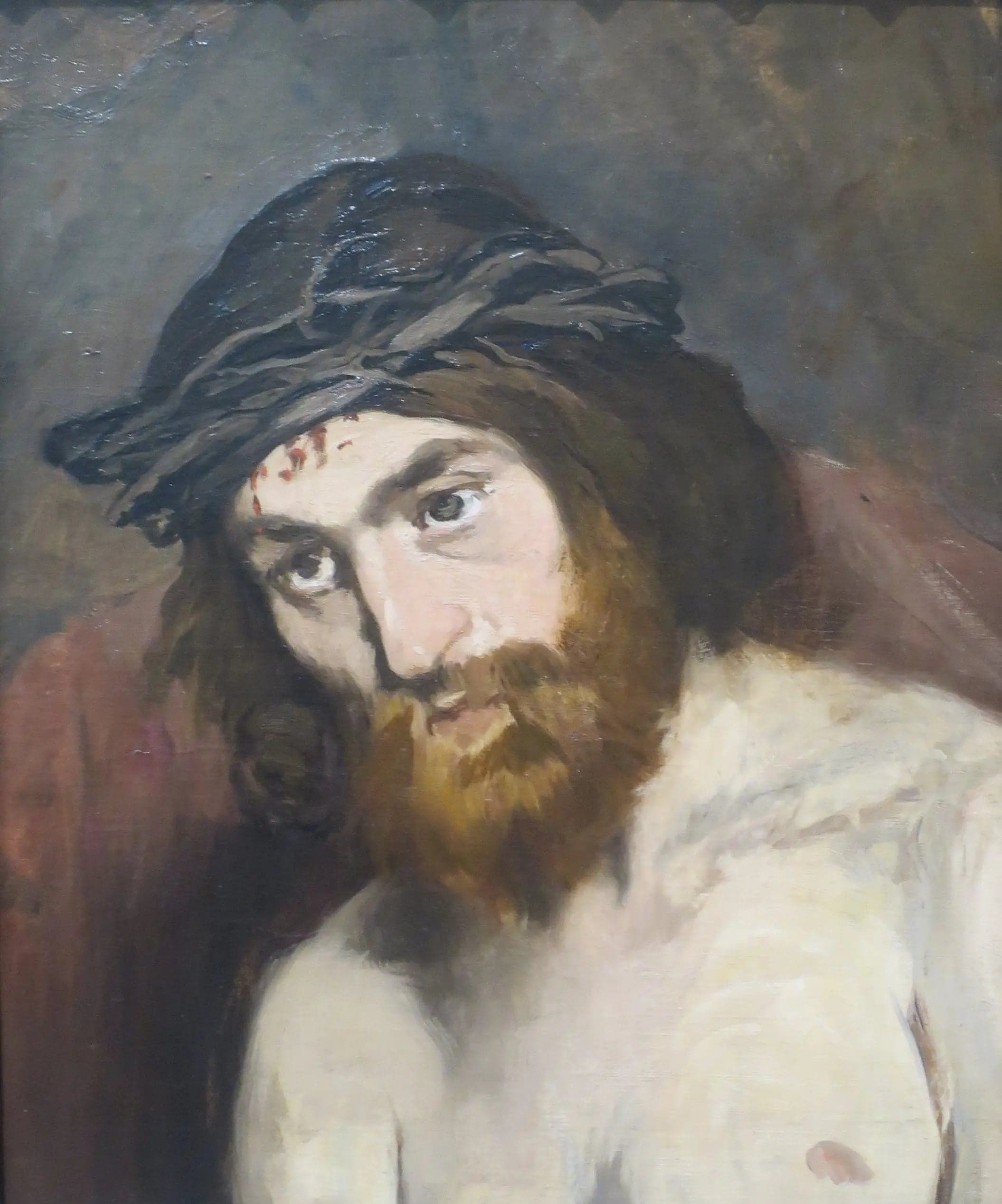
Head of Christ
- Original dimensions
- 15.25 x 18.375 cm
- Museum
- Legion of Honor
- Year
- 1865
Scene depicted
The painting “Tête du Christ” presents a serene, deeply contemplative face. The artist manages to crystallize a spiritual expression through a disturbing simplicity, inviting the viewer to introspective meditation. Christ appears not as a distant figure, but as an intimately human presence, signifying an invitation to reflect on our own beliefs.
Historical context
This painting emblematic, created in 1865, emerges in the vibrant context of Paris, the epicenter of avant-garde artistic movements. Édouard Manet , a key figure of realism and precursor of impressionism , offers us here a canvas filled with emotions that dialogues with the conventions of his time. Currently preserved at the prestigious Legion of Honor , this painting captivates with its intimate dimensions.
Place in the artist's career
In the career of Édouard Manet , this canvas marries his past experiences with an increasingly assertive style. It is not only a promising beginning but a work representative of his evolution, alongside masterpieces like “Olympia” and “Le Déjeuner sur l’herbe.” Here, Manet matures his pictorial language, amalgamating traditional styles with a bold approach that will make him famous.
Anecdote
“True beauty lies in truth” could have said Édouard Manet while contemplating a ray of light caressing the face of Christ. Inspired by a spring morning in the heart of Paris, he captured this fleeting light where the sweet scent of lilacs floated in the air. This resonance between light and form brings his composition to life, highlighting the spirituality present in the painting .