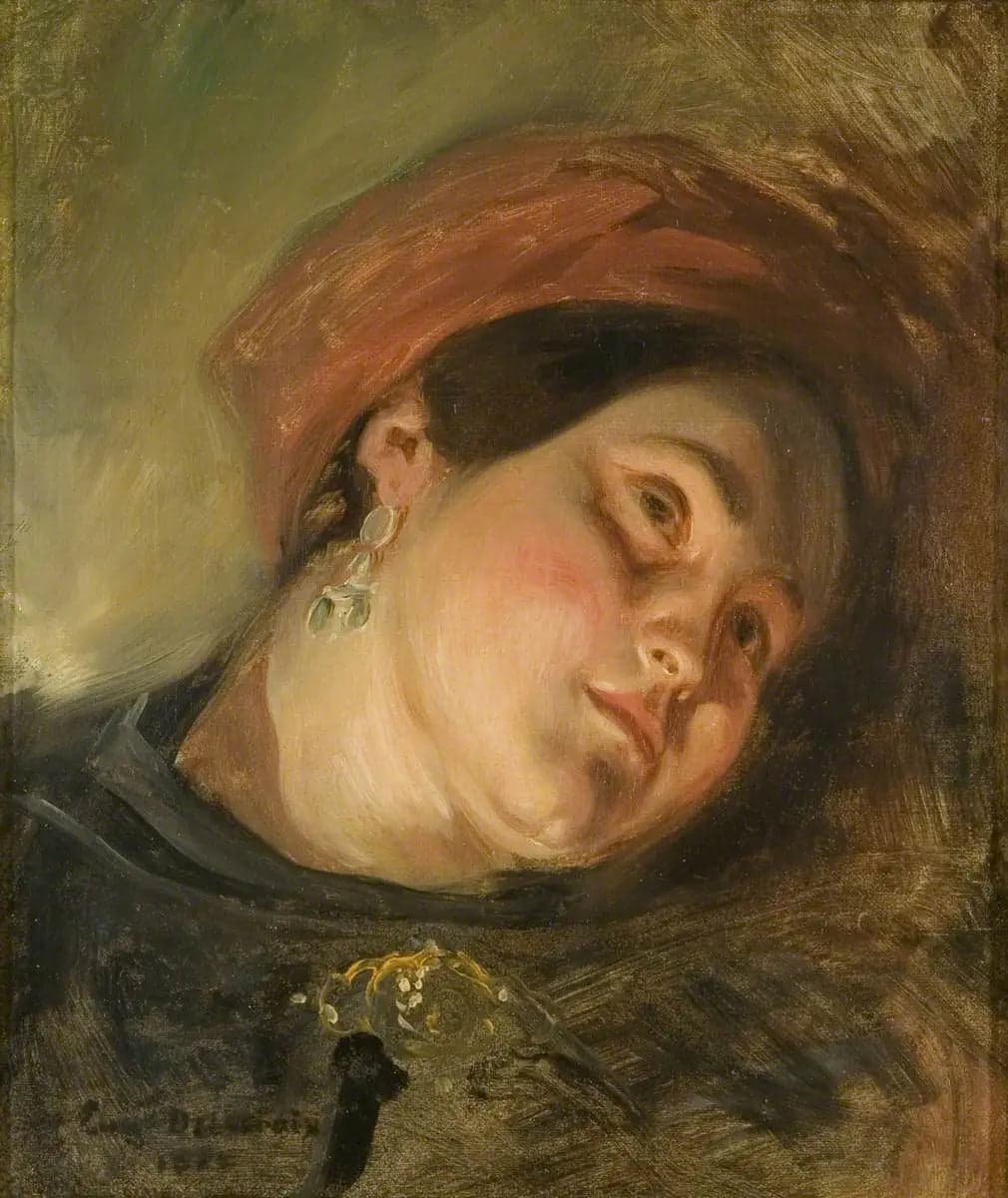
Head of a Woman with a Red Turban
- Original dimensions
- 35.3 x 41.3 cm
- Museum
- Bristol City Museum & Art Gallery
- Year
- 1831
Scene depicted
In the Woman's Head with Red Turban , Delacroix unveils a woman's face wrapped in a flamboyant turban, a symbol of exoticism and mystery. Her dignified gaze, both enchanting and pensive, speaks of the countless stories contained within her soul. This fascinating composition transcends appearance, capturing an ephemeral essence of emotion, charged with passion and curiosity.
Historical context
Created in 1831, the iconic painting Woman's Head with Red Turban finds its roots in the romantic past of the city of Paris, a nerve center of artistic innovation. This canvas belongs to the romantic movement, characterized by intense expressiveness and a quest for beauty in subjectivity. Today, the painting is preserved at the Bristol City Museum & Art Gallery, where it awakens admiration from visitors at every presentation.
Place in the artist's career
This masterpiece, Woman's Head with Red Turban , stands at a pivotal moment in Delacroix's career, revealing his artistic evolution between his bold beginnings and his later works, such as Liberty Leading the People and The Last Moments of Michel de l'Hôpital , reflecting an increasingly mature style and a vibrant palette.
Anecdote
Eugène Delacroix , while contemplating a face seen in a Paris street on a spring morning, reportedly said: “Beauty resides in the soul, and it is enough to capture it with passion.” This thought breathed life into the painting Woman's Head with Red Turban , imbued with the emotional depth of its model.