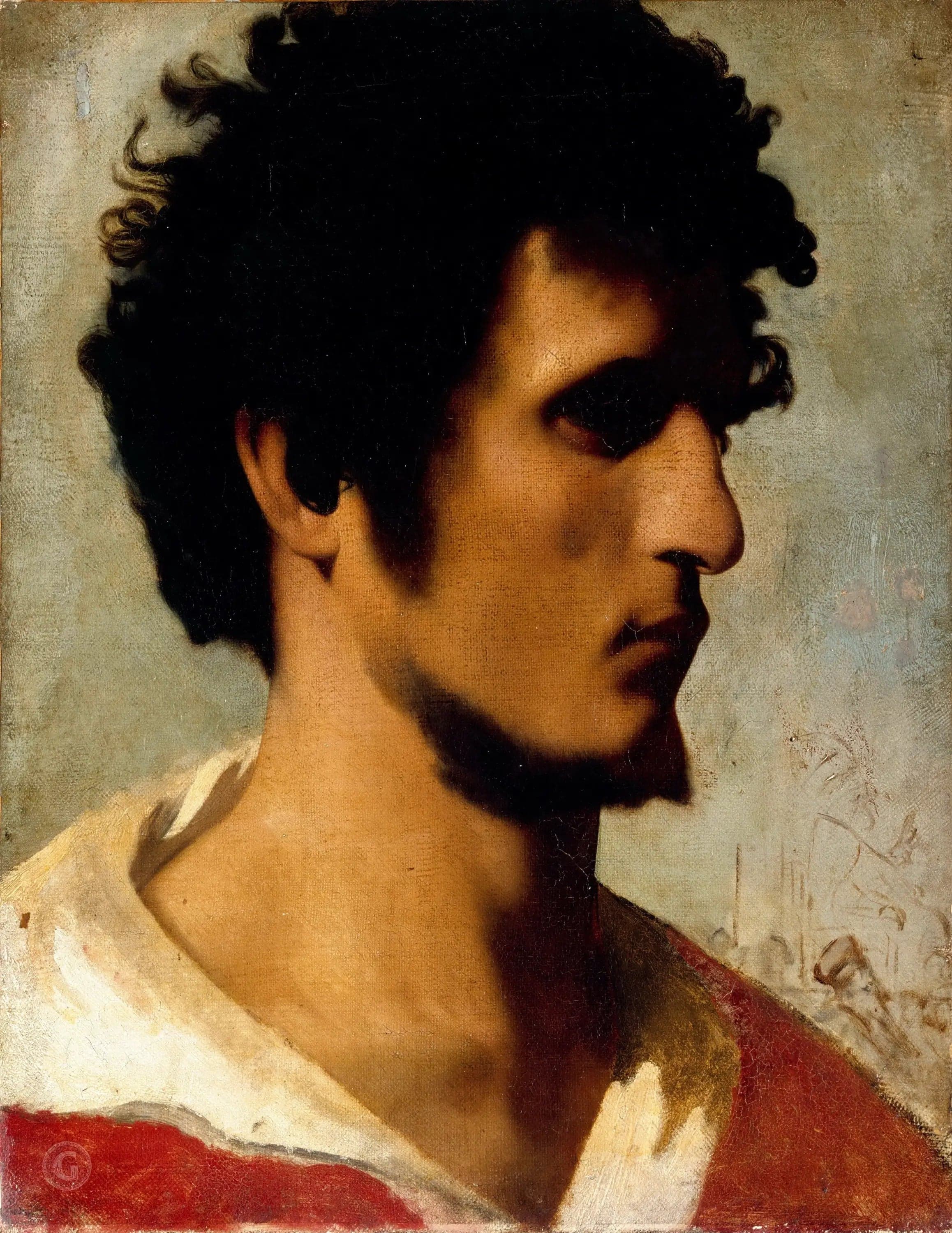
Head of a Peasant from the Roman Countryside - Jean
- Original dimensions
- 36.5 x 46.5 cm
- Museum
- Dijon
- Year
- 1844
Scene depicted
This painting depicts the face of a peasant, imbued with the warmth of the Mediterranean sun and the hard labor of the land. His features are marked by years of hard work while his gaze, both tired and wise, tells stories of past generations. Gérôme succeeds in capturing authentic humanity at the heart of this pictorial work.
Historical context
Created in 1844 in Dijon, this iconic canvas emerges from a time when realism and visual expression come together to capture everyday life. Rooted in the movement of realism , Gérôme's painting stands as a precious witness to rural France in the 19th century, evoking an atmosphere imbued with nostalgia and simplicity.
Place in the artist's career
Tête de paysan de la campagne romaine positions itself as a significant milestone in Gérôme's career. Close to masterpieces such as "Le Crier de Paris" and "La Mort de César," this canvas bears witness to the artist's evolution, where technique marries raw emotion, revealing both his maturity and his penchant for exploring the human condition.
Anecdote
Jean-Léon Gérôme once stated: "Light is the soul of my painting ." Imagine him, on a spring morning, wandering the Roman countryside in search of a face that would reveal the very essence of fieldwork. This moment of inspiration, captured in the painting , still resonates through every brushstroke.