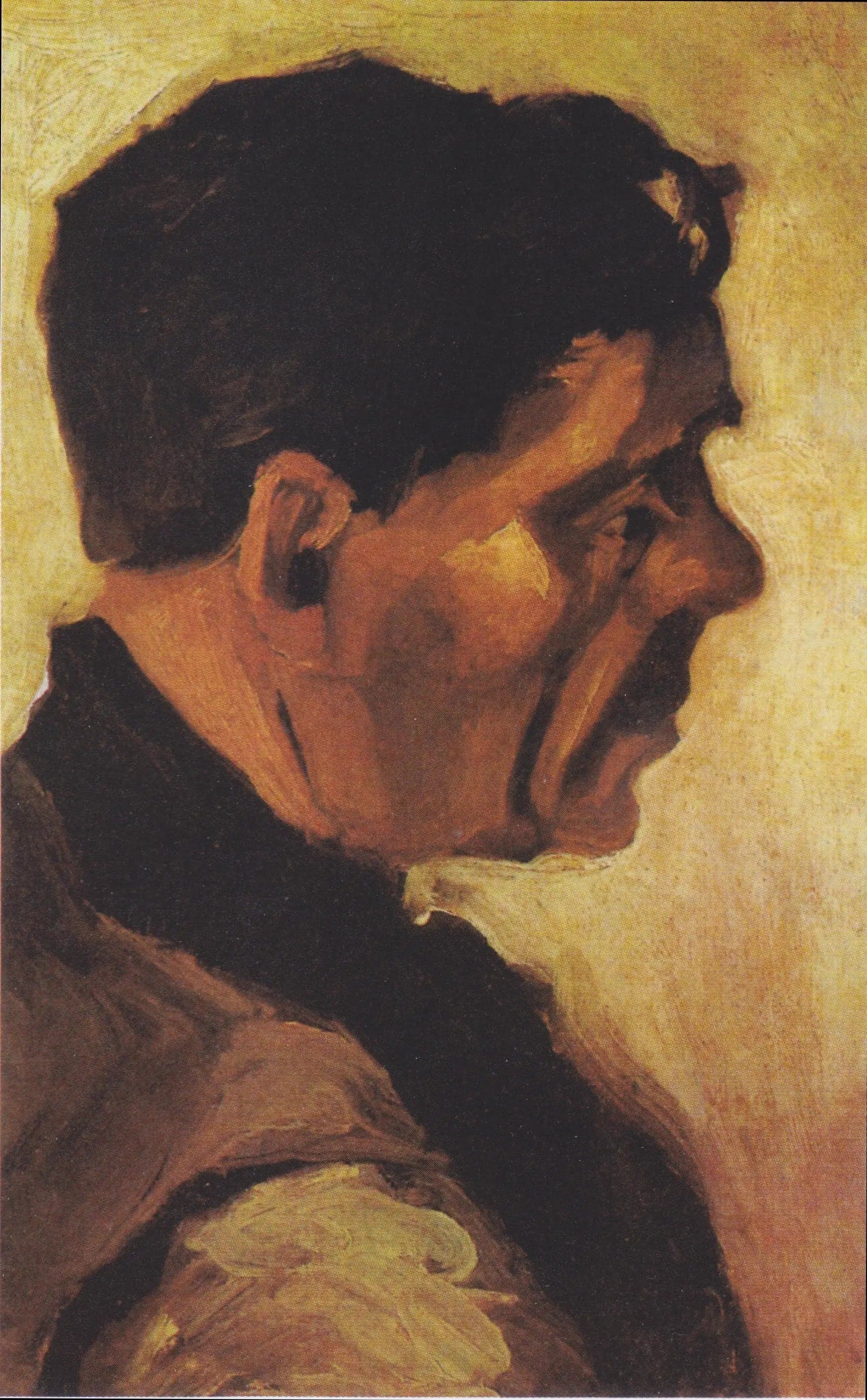
Head of a Man
- Original dimensions
- 30 x 47 cm
- Museum
- Kröller-Müller Museum
- Year
- 1885
Scene depicted
The painting “Head of Man” captures an introspective portrait of a man whose features mark a life of work and hope. The tension between shadow and light, accentuated by energetic brush strokes, tells a story of mature humanity, where each line of character is imbued with emotional depth. It is a tender look at the daily lives of men and their struggles, a humanistic impulse that Van Gogh cherishes intensely in this canvas .
Historical context
Created in 1885, this painting is emblematic of Post-Impressionism , an artistic movement that redefines the perception of art through the expression of emotions. In the peaceful village of Nuenen , Van Gogh, already in search of his own style, turns to the faces of the people to explore human depth. Today, the painting is preserved at the Kröller-Müller Museum , where it reminds everyone of the power of emotion captured on canvas.
Place in the artist's career
“Head of Man” stands as a turning point in Van Gogh's career, revealing his emerging artistic maturity. This masterpiece precedes his exploration of vibrant landscapes, diffused in works such as “ The Starry Night ” and “ The Sunflowers ”. It shows a transition to a bolder palette and a freer composition, thus enriching his distinctive technique.
Anecdote
“Beauty lies in the soul that one represents,” said Vincent, recalling the precise moment he realized that each face can tell a unique story. One spring morning, the soft light illuminated the features of a man encountered in an alley. It was this fleeting encounter that would inspire the strength and intensity of the painting Head of Man.