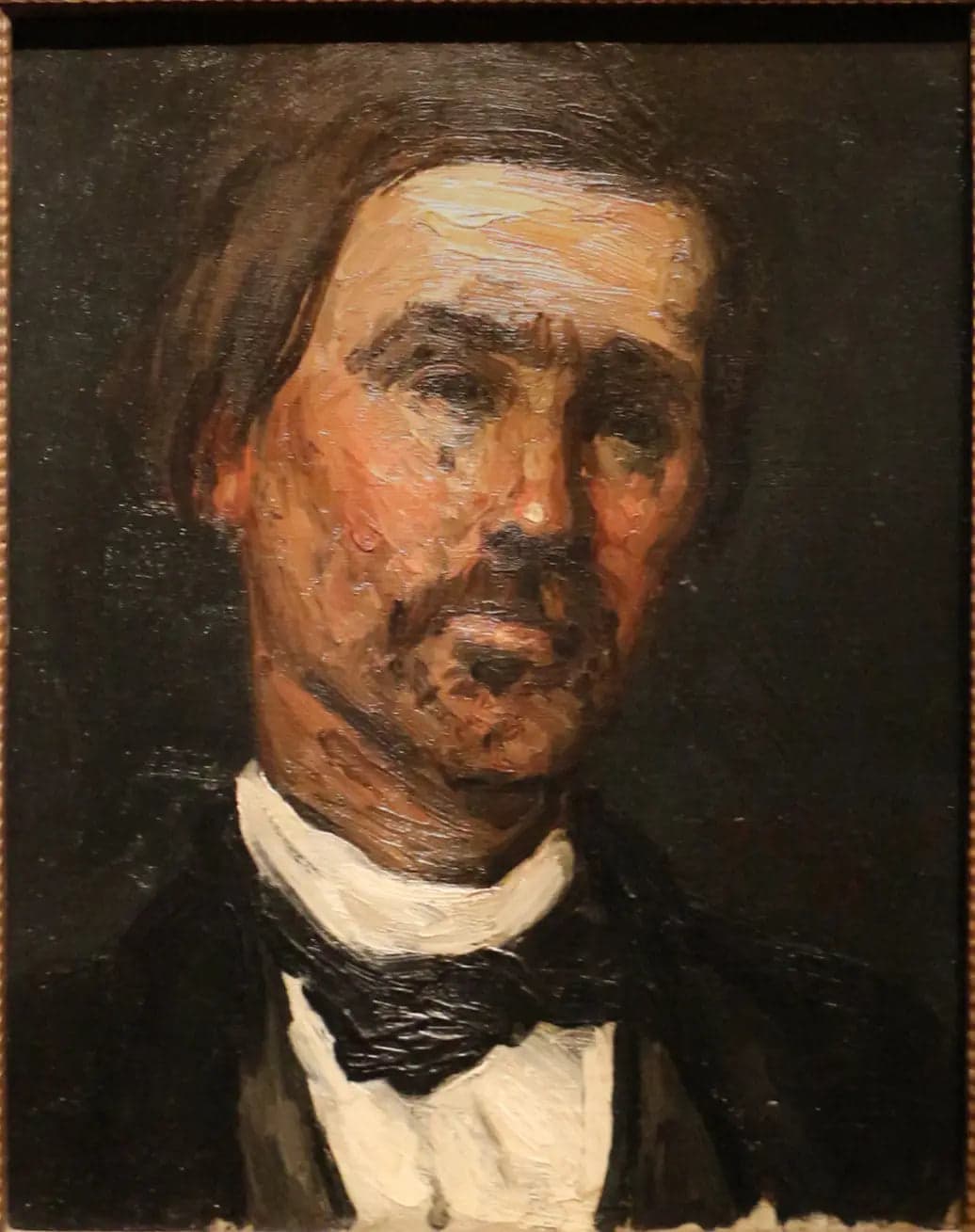
Head of a Man
- Original dimensions
- 33 x 41 cm
- Museum
- Detroit Institute of Arts
- Year
- 1865
Scene depicted
In the canvas titled “Tête d'homme,” Cézanne immerses his viewer in an introspective universe, where the intensity of the gaze seems to pierce through time. The composition, with its apparent simplicity, captures a singular portrait of a man, his features marked by the passage of time. Each brushstroke, each nuance of color, echoes countless emotions, revealing a soul behind this face.
Historical context
Created in 1865, this painting is born in the heart of the artistic effervescence of Aix-en-Provence, a period when the Impressionist movement begins to touch the creative minds. Emblematic of Post-Impressionism , the canvas stands at a crossroads, as Cézanne expands the horizons of painting. Today, this masterpiece is preserved at the Detroit Institute of Arts , a sanctuary of culture where its dimensions of 33 x 41 cm captivate visitors.
Place in the artist's career
“Tête d'homme” represents a significant milestone in Cézanne's artistic evolution. Situated at a pivotal moment in his career, this painting testifies to his search for structure and color. Alongside works such as “The Card Players” and “Mont Sainte-Victoire,” this canvas shows his transition from a realistic approach to a more personal and avant-garde vision.
Anecdote
“Art is merely a simple imitation of nature, but with the strength of a gaze,” Cézanne might have declared. Inspired by a face encountered on a misty morning, this canvas quickly becomes an empathetic reflection of his inner world. The painting evokes the depth and intensity of a fleeting encounter, illustrating how art can transfigure reality.