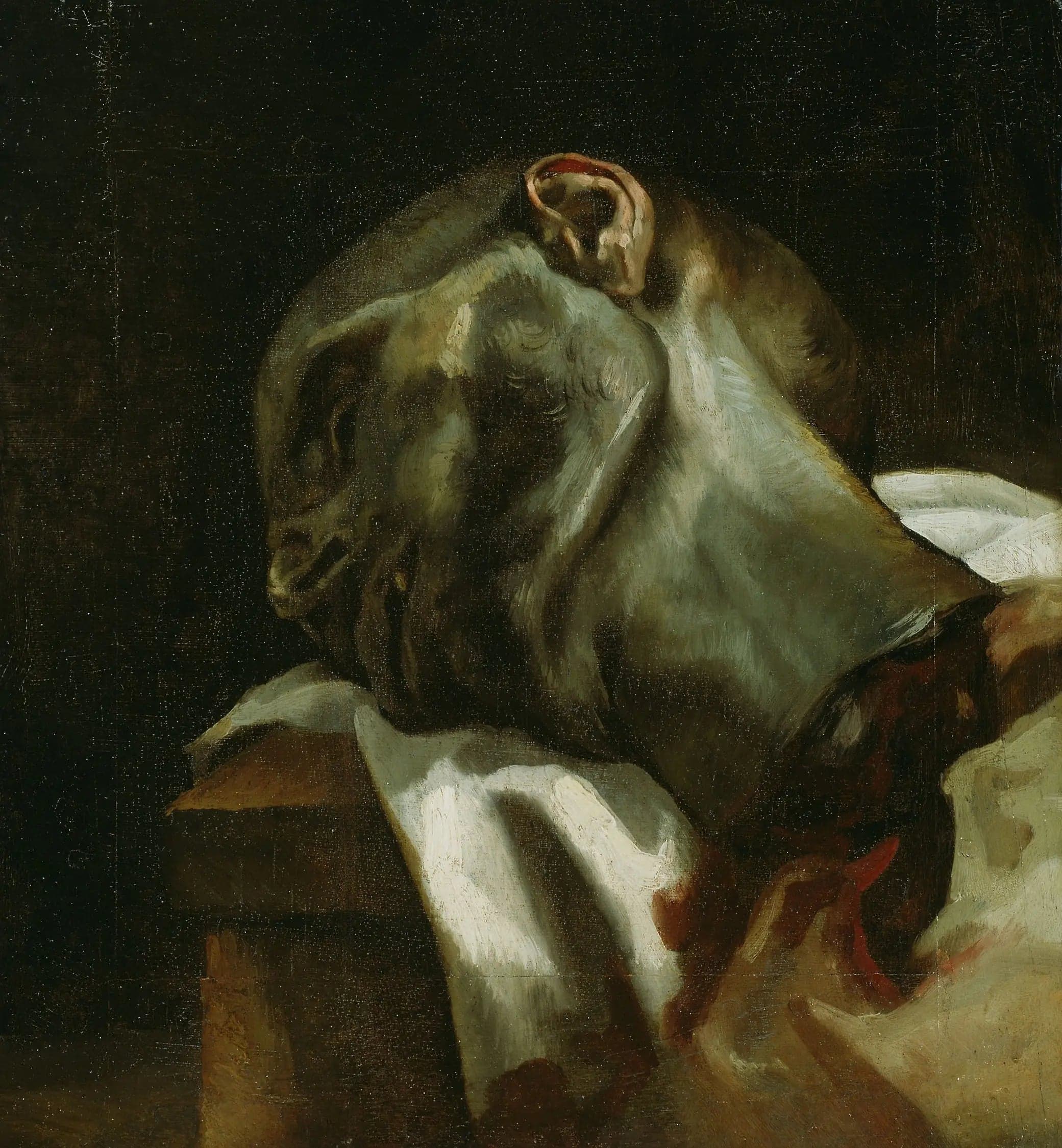
Head of a Guillotined Man
- Original dimensions
- 38 x 41 cm
- Museum
- Art Institute of Chicago
- Year
- 1818
Scene depicted
This oil painting, both striking and disturbing, represents the lifeless face of a man, a testament to a bloody public trial. By capturing the decapitation with surgical precision, Géricault combines the real with the imaginary, making us feel the anguish and revolt against blind justice. Every detail of this composition reflects a tormented era.
Historical context
Created in Paris in 1818, Head of a Guillotined Man belongs to the romantic movement, characterized by an intense emotional exploration and a reaction to the rationality of the Enlightenment. This painting , emblematic of its time, provokes reflection on mortality and the human condition. Currently exhibited at the Art Institute of Chicago , this canvas captures a moment that is both dramatic and poignant, with dimensions of 38 x 41 cm that reveal its narrative power.
Place in the artist's career
Head of a Guillotined Man stands as a pivotal moment in Géricault's career, marking his rise to fame. Alongside paintings such as The Raft of the Medusa and The Master of Assassination , this work reveals his commitment to troubling subjects, as well as his technical evolution, highlighting the growing emotional strength that characterizes him.
Anecdote
“The death of a man is the life of a work.” said Géricault, inspired by the tragedy of a reality he encountered. One foggy morning, wandering near the Parisian guillotine, he came across a face marbled with suffering, marking the beginning of his masterpiece . This deep inspiration is felt in the evocative strength of Head of a Guillotined Man .