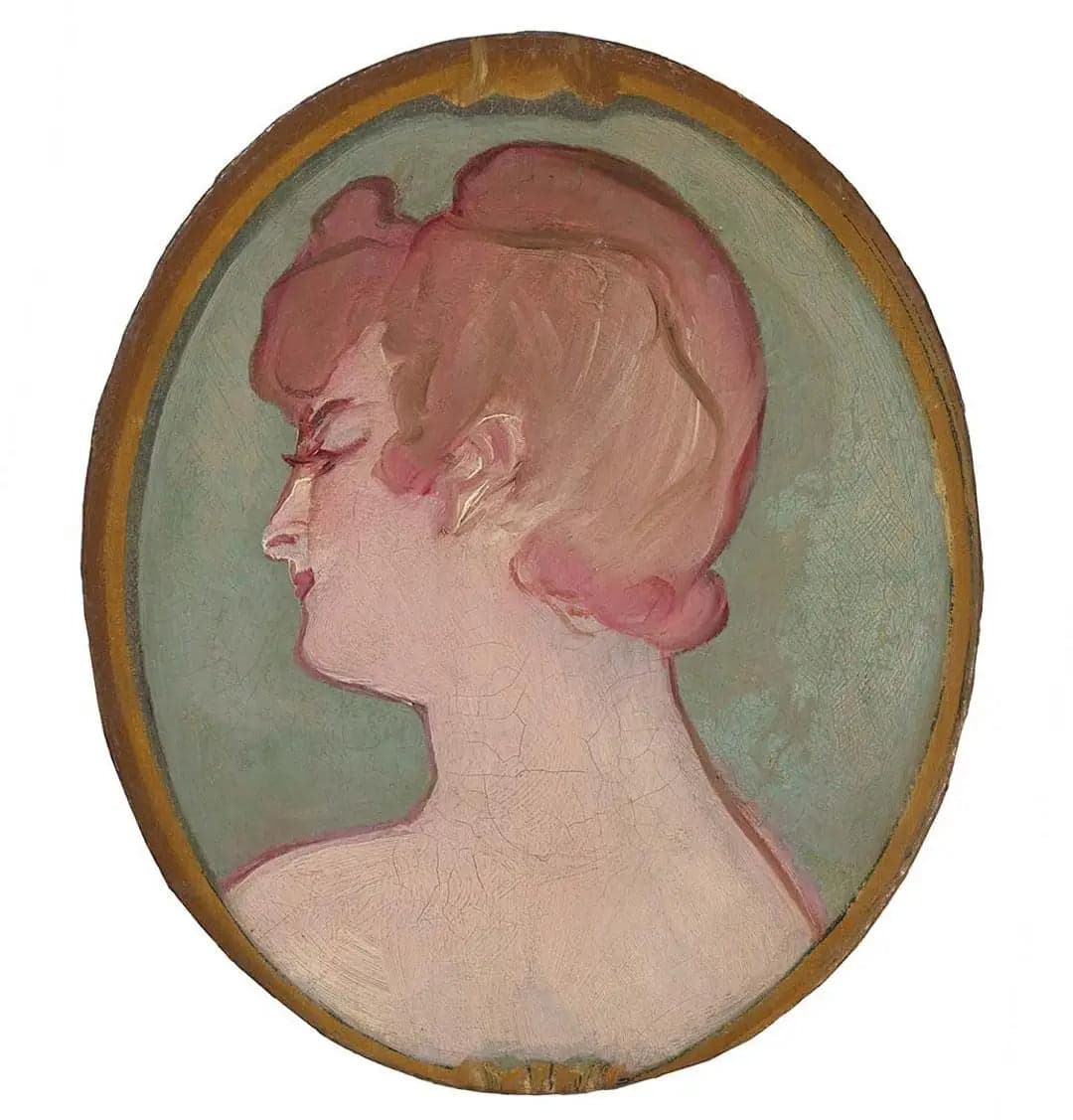
Head of a Girl - Henri de Toulouse
- Original dimensions
- 23 x 27.3 cm
- Museum
- Queensland Art Gallery & Gallery of Modern Art
- Year
- 1892
Scene depicted
"Girl's Head" presents a delicate, intimate, and evocative portrait, where one perceives the depth of human emotion through the captivating gaze of the subject. Toulouse-Lautrec seizes the face of this young woman, a true echo of damaged beauty, making her unforgettable. This painting evokes the subtleties of Parisian lights, creating an atmosphere that is both romantic and melancholic, true to the bohemian spirit of the capital.
Historical context
Created in 1892 in the vibrant city of Paris, at the heart of the Belle Époque, the painting "Girl's Head" is part of an innovative artistic movement, that of post-impressionism . Toulouse-Lautrec, a leader of this movement, immersed himself in Parisian nightlife, capturing the spiritual essence of this fascinating era. Currently, this remarkable canvas is exhibited at the Queensland Art Gallery & Gallery of Modern Art, testifying to the lasting impact of the work. Its dimensions denote a particular delicacy: 23 x 27.3 cm.
Place in the artist's career
This masterpiece embodies a turning point in Toulouse-Lautrec's career, marking a period of stylistic maturity. Echoing other works like "At the Moulin Rouge" and "La Goulue," "Girl's Head" testifies to an evolution in the way he captures the personality of his models. It is a transition towards greater introspection in his compositions.
Anecdote
"Beauty is in the ephemeral," Toulouse-Lautrec once confided to a friend, evoking the fleeting moment of a meeting on the Parisian pavement. It is this breath of life that animates the canvas of "Girl's Head," a frozen moment, illustrating youth while capturing the mysterious soul of its model. In this painting, each brushstroke whispers the story of a life to be discovered.