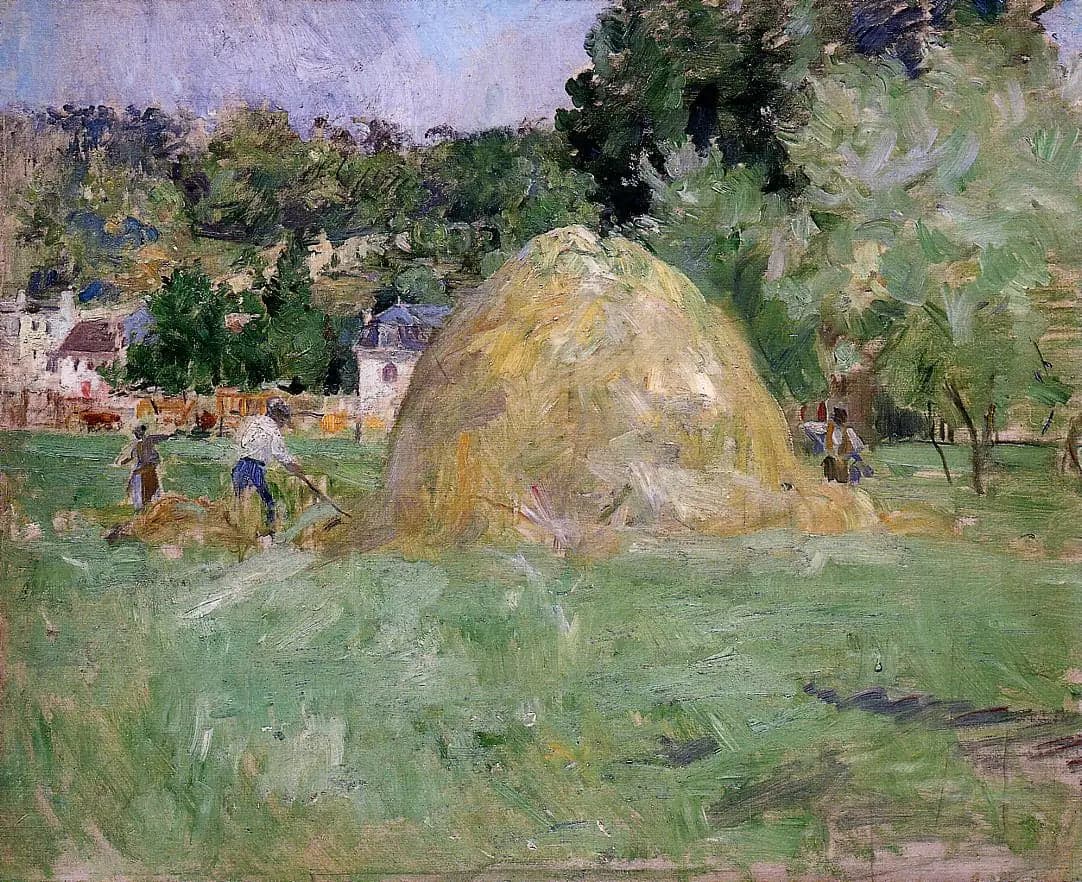
Haystacks at Bougival
- Original dimensions
- 61 x 50 cm
- Museum
- Marmottan Monet Museum
- Year
- 1883
Scene depicted
In “The Haystacks at Bougival,” Morisot captures a bucolic scene where one can see haymakers at work, enveloped by the warmth of a summer day. The blurred forms indicate delicate movement, while the elongated shadows highlight the beauty of nature. The frozen moment reflects daily life, but also a sense of escape, a haven of peace in the heart of Parisian frenzy.
Historical context
Created in 1883, this painting is a reflection of a bright summer in Bougival, a charming commune in the Paris region. Inscribed in the Impressionist movement, the canvas symbolizes the shift towards a new artistic perception where light and color reign supreme. The painting , preserved at the Marmottan Monet Museum in Paris, attracts visitors with its intimate and striking dimension.
Place in the artist's career
This painting comes after other iconic works by Morisot, such as “The Cradle” or “Reading,” reflecting an evolution towards a bolder approach to colors and textures. “The Haystacks at Bougival” represents a turning point, where the artist integrates elements of sensuality and depth, marking her transition to a period of artistic maturity.
Anecdote
“I have always sought to capture that fleeting light that dances over the fields,” said Morisot. It was on a sunny morning, while she was strolling along the banks of the Seine, that the idea for this pictorial work took root. The gentle melody of the wind and the scent of fresh hay nourished the inspiration for this painting , offering vitality to her masterpiece .