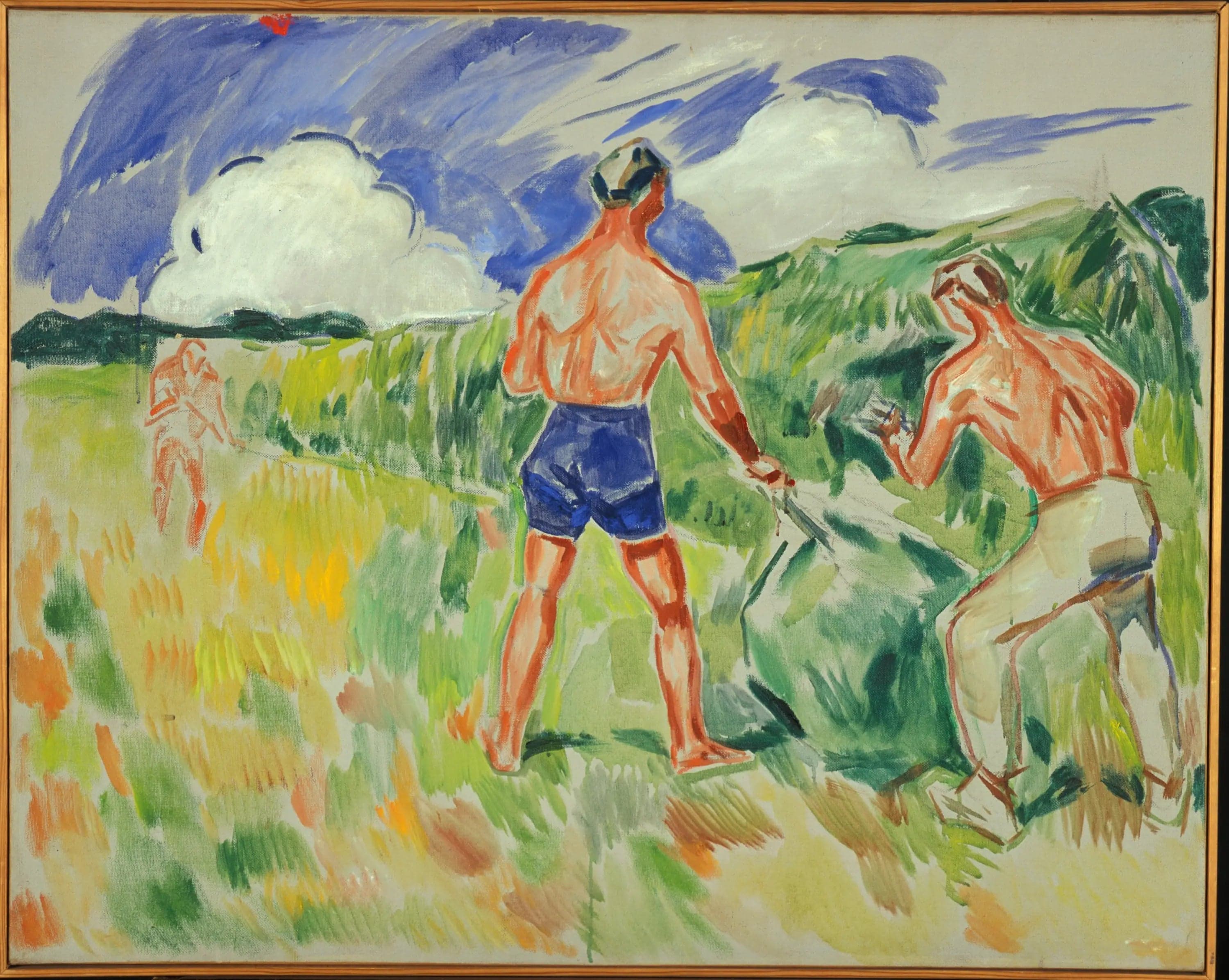
Haymaking
- Original dimensions
- 92 x 73.5 cm
- Museum
- Munch Museum
- Year
- 1942
Scene depicted
The painting “Haymaking” depicts a rural landscape at the crucial moment of harvest. The figures move between shadows and light, in search of harmony between man and nature. This painting, a true celebration of natural cycles, succeeds in capturing the essence of life in the countryside, imbued with serenity and hard work.
Historical context
Created in 1942, in the heart of Norway, the canvas Haymaking by Edvard Munch is set in an artistic context marked by expressionism . This painting, closely linked to rural life, evokes a time when agricultural scenes were omnipresent in the collective imagination. Currently, this work is exhibited at the Munch Museum in Oslo, where it continues to captivate generations of admirers with its majestic dimensions.
Place in the artist's career
Positioned at the crossroads of his career, this painting resonates with earlier works like The Scream and The Madonna , revealing Munch's stylistic and emotional evolution. Haymaking represents a period of maturity, where the artist combines his personal expression with collective scenes of daily life.
Anecdote
“Nature is my greatest inspiration,” said Munch, recalling a peaceful morning during which he discovered the vibrant nuances of light in a hayfield. This fleeting moment would become the creative spark of this masterpiece , immortalizing a simple yet deeply emotional vision.
Major exhibitions
Munch og Ekely: 1916-1944