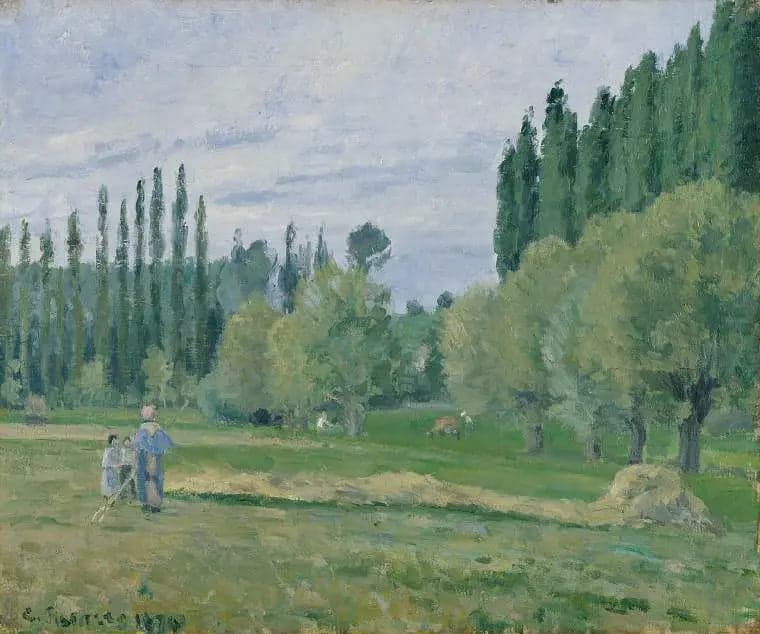
Haymaking
- Original dimensions
- 54.8 x 45.5 cm
- Museum
- Fitzwilliam Museum
- Year
- 1874
Scene depicted
This painting evokes a delicate scene of haymaking, where nature silently mingles with the work of men. Under a sky imbued with softness, the silhouettes of the mowers emerge, capturing the movement of the lush fields. This work, intimate and peaceful, reflects the simplicity and beauty of rural daily life.
Historical context
Created in 1874, the painting emblematic "Haymaking" stands out for its attachment to the Impressionist movement and its roots in Normandy, France. This period is marked by a upheaval of artistic codes, where light and color take precedence over form. Today, this canvas is preserved at the Fitzwilliam Museum , a prestigious setting that houses art treasures in the heart of Cambridge.
Place in the artist's career
"Haymaking" represents a key stage in Pissarro's career, attesting to his artistic evolution. Between the painting "The Floor Scrapers" and "Boulevard Montmartre, Spring," this work shows a stylistic maturation that combines a harmonious composition with a gaze always full of life on the countryside, his first muse.
Anecdote
"Every stroke of my brushes seeks to capture the indescribable light." This is how Camille Pissarro , in the midst of the Norman countryside, felt the call of nature. One spring morning, to the soothing sound of the mowers and enveloped by the scents of cut grass, he sketched this canvas whose pure emotion shines through in every brushstroke.