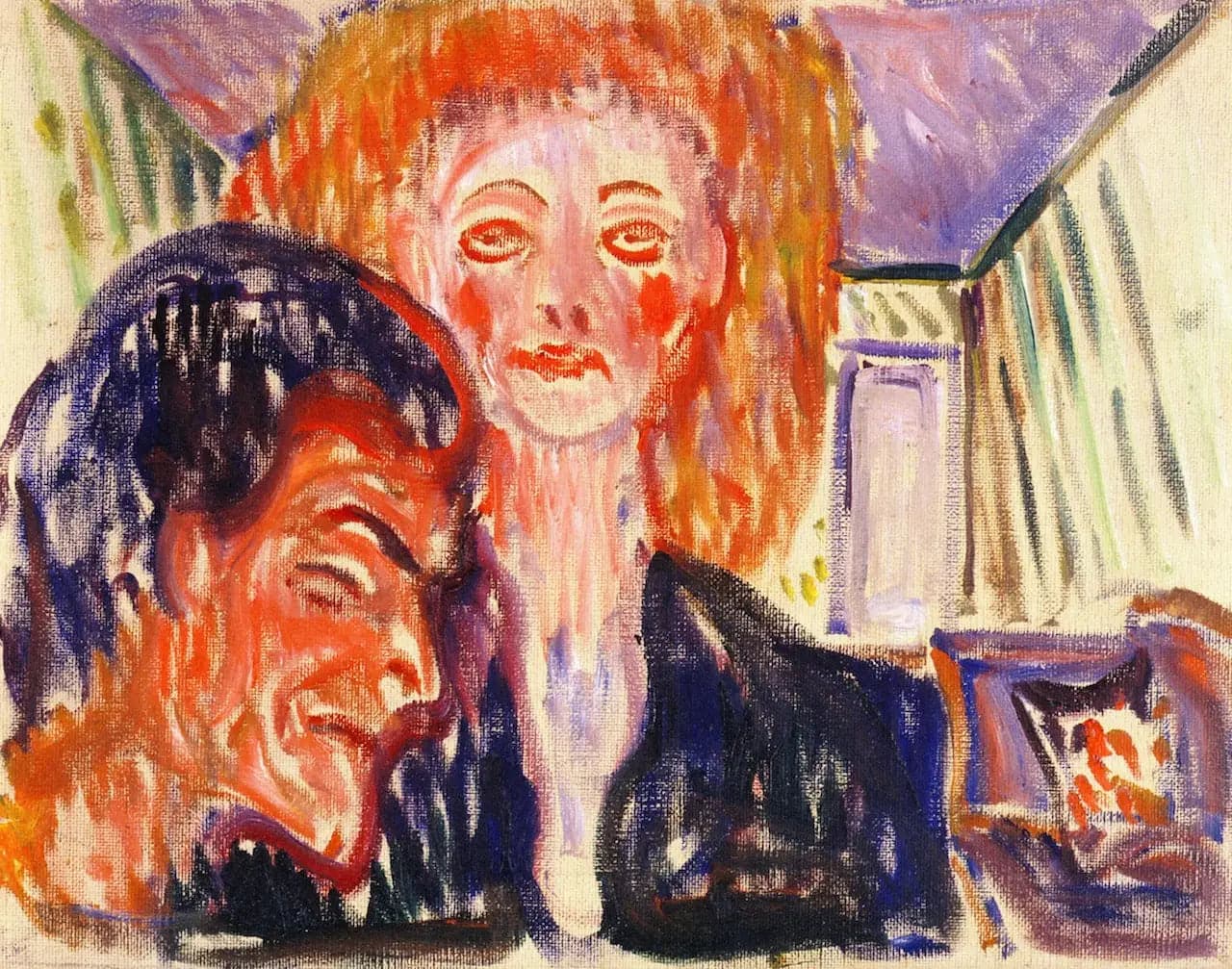
Hate
- Original dimensions
- 60 x 47 cm
- Museum
- Munch Museum
- Year
- 1907
Scene depicted
The canvas Hate illustrates a scene charged with palpable tension. The characters, enveloped in a whirlwind of fiery colors, seem to symbolize the depths of human anger and twisted relationships. This masterpiece draws the viewer into a maelstrom of emotions, where the alliance of figures and hues evokes a silent scream of despair and inner conflict.
Historical context
Created in 1907, the painting titled Hate represents a pivotal moment in Norwegian expressionism , set against the cultural backdrop of Oslo, then known as Christiania. The tumultuous political and social context of the time certainly influenced this canvas , whose emotional impact is still felt through the years. Currently, this work is preserved at the Munch Museum , a sanctuary dedicated to the art of this master, where it is admired by visitors from around the world.
Place in the artist's career
Positioned among Munch's iconic paintings , Hate stands at a turning point in his career. As he explores the meanders of the human psyche, this painting shares thematic similarities with other works, such as The Scream and The Madonna , each marked by an increasing emotional intensity and a bold application of color.
Anecdote
“There is nothing more powerful than a pure emotion.” These words, which one could imagine being spoken by Edvard Munch , resonate with the intensity he imbues in his painting . The inspiration for Hate was born on a dark evening, in a mysterious alley, cradled by the whisper of the wind and dancing shadows. It is there, in this troubled atmosphere, that the artist found the emotional strength that animates his masterpiece .
Major exhibitions
Munch og Warnemünde: 1907-1908