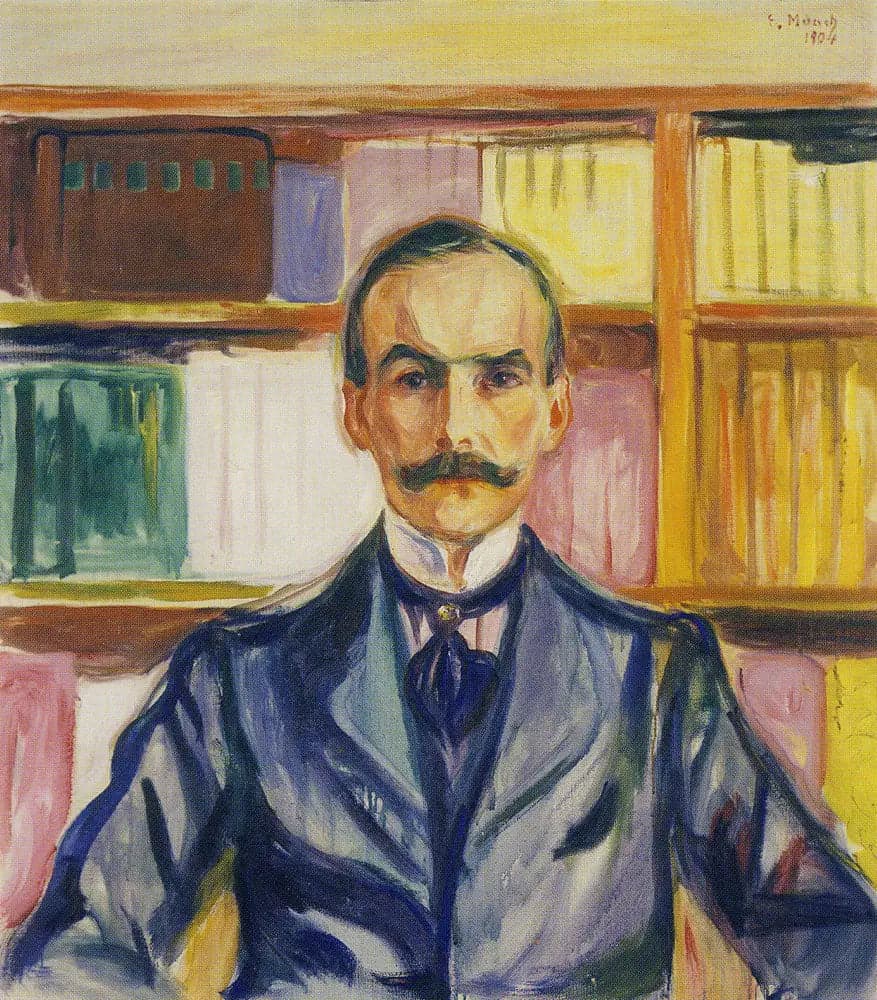
Harry Graf Kessler
- Original dimensions
- 84 x 200 cm
- Museum
- Neue Nationalgalerie
- Year
- 1906
Scene depicted
In this painting, Edvard Munch immortalizes not only a portrait but a deep essence. Kessler, a man of spirit and culture, is captured with an intensity that goes beyond mere features, the emotions intertwined in his face reveal a fascinating introspection. The composition comes to life, oscillating between light and darkness, where each brushstroke resonates with emotional intensity.
Historical context
Created in 1906, the painting "Harry Graf Kessler" is part of the expressionist movement, born from a tumultuous era. It was in Berlin, a vibrant and innovative city, that this canvas came to life. Confronted with political and social realities, the work captures the essence of a pivotal moment in art history, where human emotion flourishes on the canvas. The painting now rests at the Neue Nationalgalerie, where its creative breath continues to intensify the air laden with erudition, its imposing size echoing the spiritual aspirations of its time.
Place in the artist's career
"Harry Graf Kessler" represents a pivotal moment in Munch's career. Following the successes of "The Scream" and "The Madonna," this painting reflects an artistic maturity. It results in an evolution towards more introspective portraits, such as those of "The Woman with a Hat" and "The Portrait of Wally Neuzil," marking a deepening in human emotions.
Anecdote
"Every face is an open book, written by life itself," said Munch. It was on a bright morning that the artist crossed paths with the deep gaze of Harry Graf Kessler, inspiring this striking pictorial work . The connection between painter and subject seems infinite, a frozen moment where humanity meets art, creating a strong emotional echo, a vibration persists in the hollow of the painting .
Major exhibitions
Edvard Munch : portretter