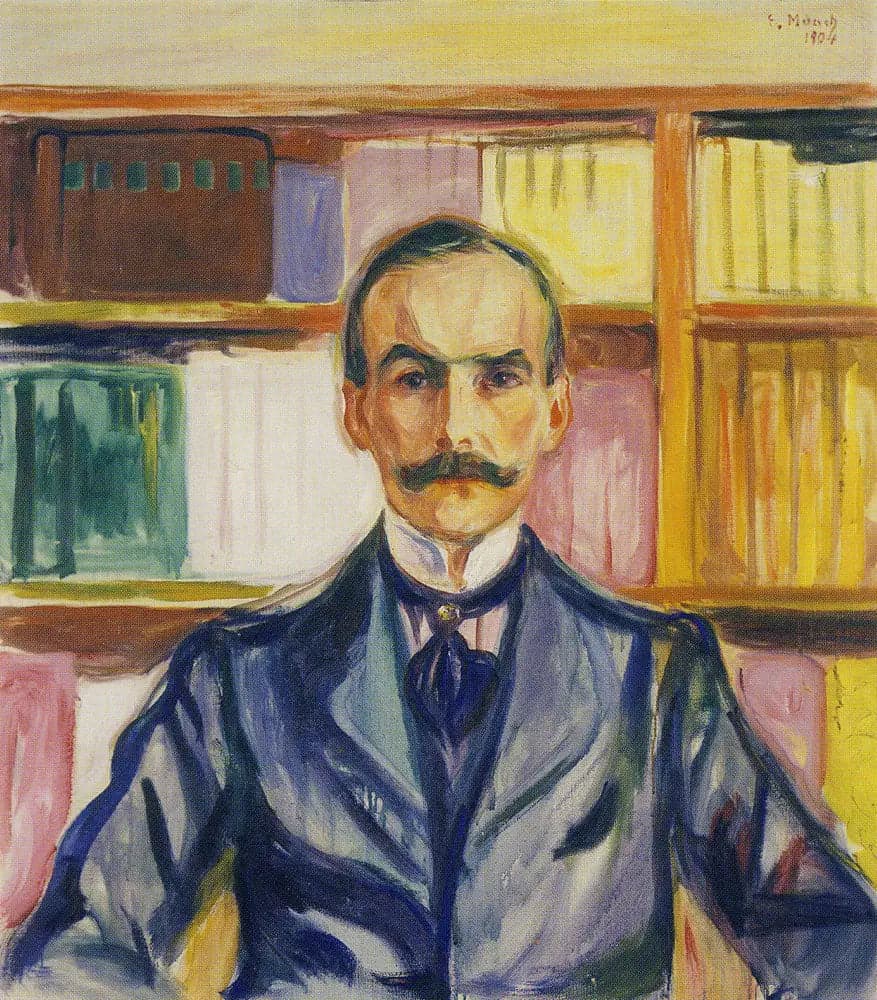
Harry Graf Kessler
- Original dimensions
- 77.5 x 122.5 cm
- Museum
- Stenersen Museum
- Year
- 1906
Scene depicted
The painting "Harry Graf Kessler" illustrates a striking portrait of the count, combining delicacy and intensity. Under the soft light, Kessler's face, glowing with human warmth, becomes a symbol of the artistic and intellectual relationships that united Munch and his contemporaries, evoking a time of vibrant creativity.
Historical context
Created in 1906, the iconic painting "Harry Graf Kessler" by the Norwegian artist Edvard Munch is a key work of the expressionist movement. Made in Oslo, this canvas stands out for its deep emotions and exploration of psychological themes, characteristic elements of the early 20th century. Currently, the painting is located at the Stenersen Museum in Oslo, an emblem of the artistic innovation of the time.
Place in the artist's career
Significantly, this painting represents a period of maturity for Munch, reflecting a technical refinement. At this time, the artist had already created other notable paintings such as "The Scream" and "The Madonna," marking an evolution towards a deeper exploration of human feelings.
Anecdote
Edvard Munch once stated: "Painting is the music of sensation." It was at the dawn of a Norwegian spring, in a quiet alley, that he was inspired to capture the intensely expressive gaze of Count Kessler. This encounter became an inexhaustible source of emotions and nourished the soul of the canvas , resonating through the layers of colors.
Major exhibitions
Edvard Munch : portretter