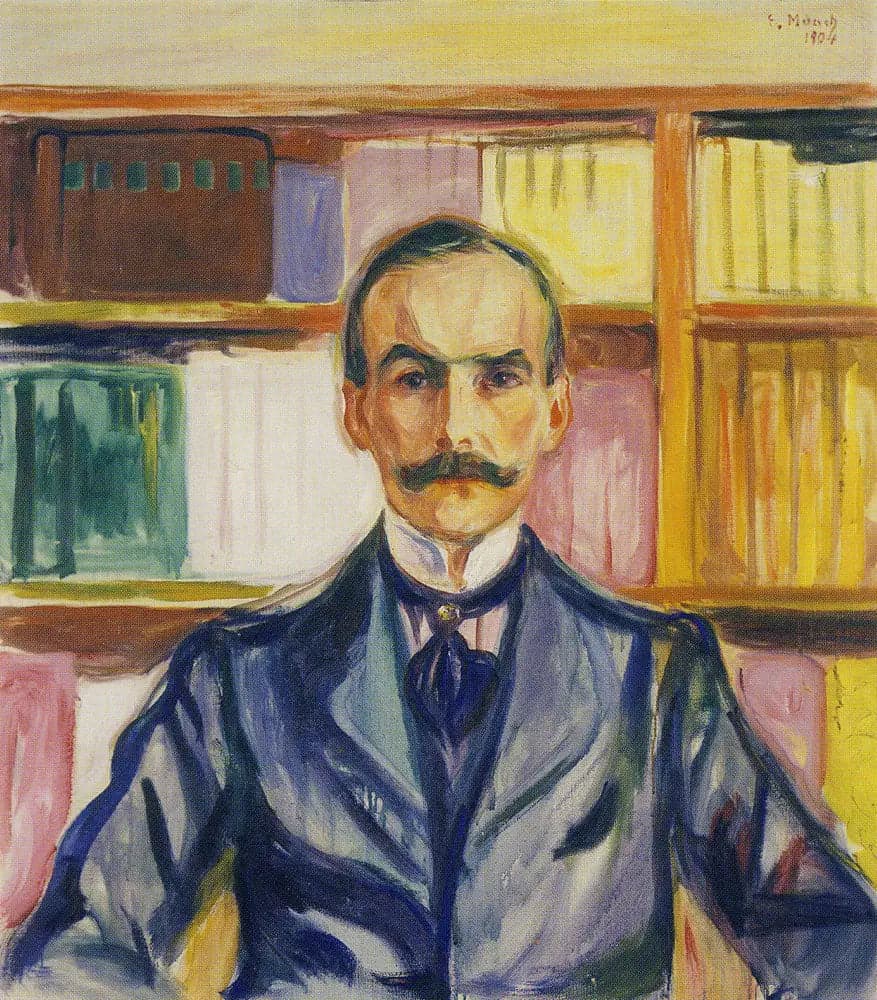
Harry Graf Kessler
- Original dimensions
- 75 x 86 cm
- Museum
- Not specified
- Year
- 1904
Scene depicted
In the painting “Harry Graf Kessler,” Munch captures the complex psychology of the figure of Kessler, a man both rooted in artistic reality and tormented by his own reflections. A symbol of introspection, this character, exalted by dark and intense colors, seems to converse with his environment, transporting the viewer into an atmosphere charged with passion and anxiety. The layers of paint offer visual depth, thus accentuating the emotional tension present in the composition.
Historical context
It is in the heart of an era marked by a quest for expression and modernity that Edvard Munch unveils his masterpiece, Harry Graf Kessler , in 1904. In this iconic canvas, the Norwegian artist roots himself in the symbolist movement, exploring the depths of the human soul, while Europe experiences profound cultural upheavals. This painting , whose current place of conservation remains unclear, is an invitation to dive into the meanders of the psyche, with dimensions of 75 x 86 cm that characterize the imposing presence of this pictorial work .
Place in the artist's career
Harry Graf Kessler positions itself as a significant work in Munch's career, testifying to his relentless search for authenticity. It appears after his famous paintings such as “The Scream” and “The Madonna,” translating an evolution towards a more introspective and personal style. This painting, at the crossroads of stylistic paths, reveals the artistic maturity of the artist and his ease in manipulating the canvas to make a powerful visual statement.
Anecdote
“There are emotions that I can only capture with my brush,” Munch said one spring morning, in the soothing calm of his studio. It is in this inspiring place, where shadows and lights dance, that he conceived Harry Graf Kessler . As a reflection of his own inner struggle, this painting becomes a mirror of emotions, seeking to translate a universal human experience through painting .
Major exhibitions
Edvard Munch : portretter