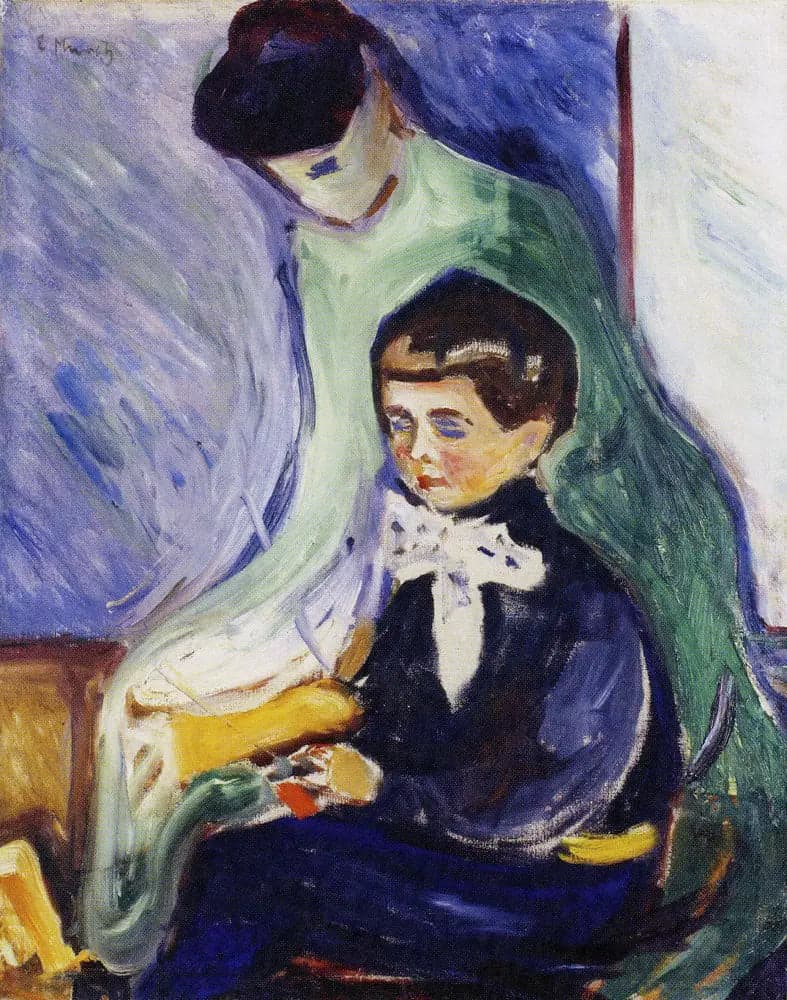
Hans Herbert Esche and his nanny
- Original dimensions
- 57 x 73 cm
- Museum
- Not specified
- Year
- 1905
Scene depicted
In this pictorial work, Munch stages the tender relationship between the child and his nanny, enveloping the composition in a delicate and intimate atmosphere. The painting depicts an everyday scene, but every detail evokes the depth of feelings: the softness of glances, the serenity of a shared moment, and the gentleness of light filtering through this fragile bubble of happiness.
Historical context
Created in the heart of the first decade of the 20th century, the painting Hans Herbert Esche and his nanny by Edvard Munch is part of the expressionist movement, an artistic current that favored emotion and subjectivity. This canvas comes from the vibrant city of Oslo, Norway, and was born within a cultural context marked by tumultuous changes. The painting , although not currently exhibited in a specific museum, is a centerpiece that illustrates the psychological depth of the characters that Munch explores.
Place in the artist's career
Hans Herbert Esche and his nanny represents a turning point in Munch's career, as he navigates here between figuration and the experimentation of human emotions. In parallel, other paintings like The Scream and The Madonna testify to this evolution towards bolder stylization, where each work aims to be a deep exploration of feelings.
Anecdote
“Every face is a window to the soul,” Munch might have said as he laid the first brush strokes on this masterpiece . Inspired by a sweet spring morning, with the voices of children playing outside still resonating in his mind, he sought to capture the essence of childhood and protection, symbolized by this powerful painting .
Major exhibitions
Edvard Munch : portretter