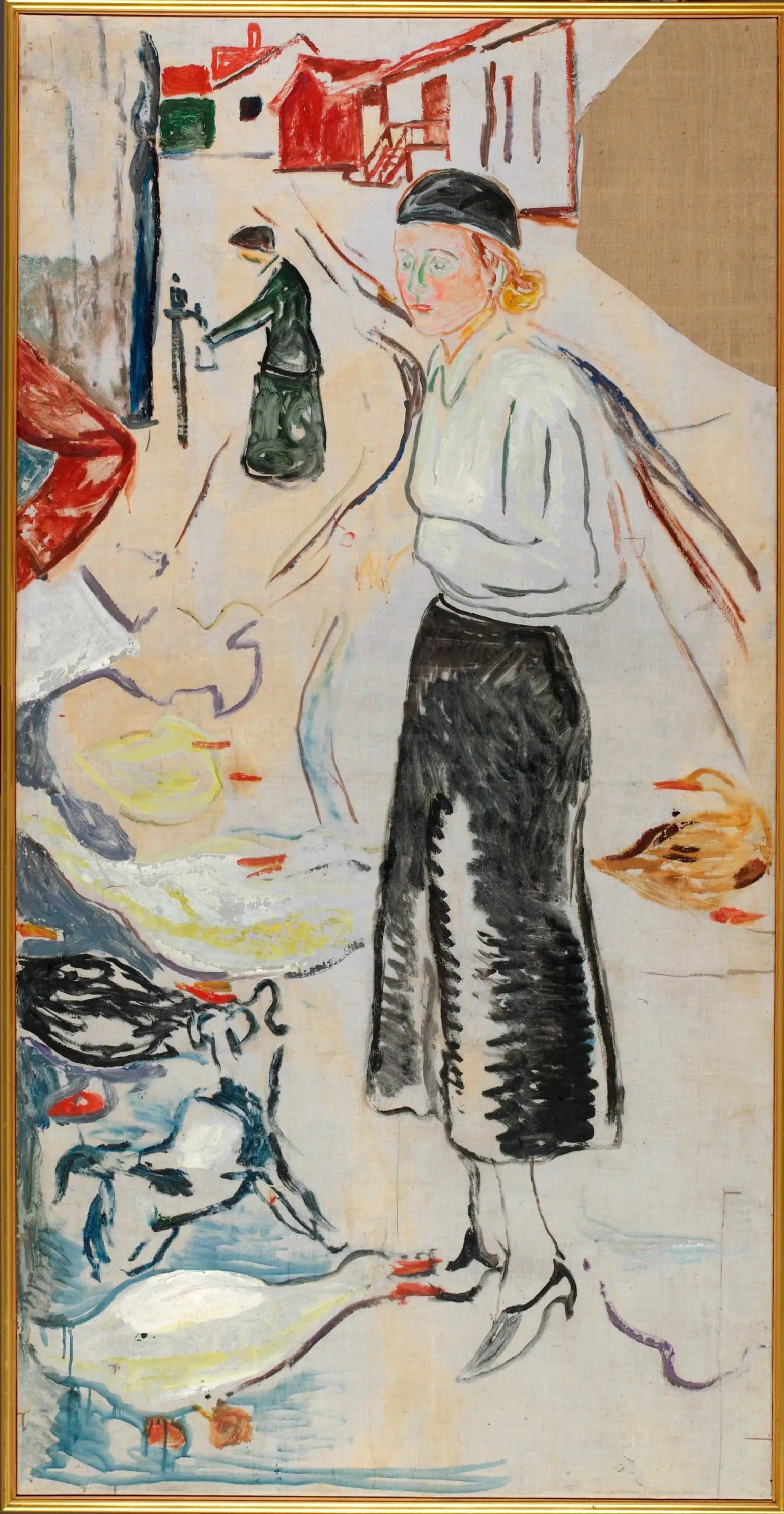
Hanna Brieschke in Åsgårdstrand
- Original dimensions
- 104.5 x 205.5 cm
- Museum
- Munch Museum
- Year
- 1932
Scene depicted
In this pictorial work, Munch depicts Hanna Brieschke, a woman who seems to be in a moment of contemplation. Against the backdrop of Åsgårdstrand landscapes, soft lights and delicate shadows blend to create an atmosphere imbued with melancholy and serenity. Each brushstroke makes palpable the echo of a troubled inner life, reflecting an era sensitive to the nuances of human emotion.
Historical context
Created in 1932, Hanna Brieschke à Åsgårdstrand is an iconic canvas from the Norwegian coastal town of Åsgårdstrand. This work is part of the expressionist movement dear to Edvard Munch , an artist whose creations capture the very essence of the human psyche through vibrant landscapes and evocative portraits. This painting is currently housed in the Munch Museum in Oslo, remaining a centerpiece of his cultural heritage.
Place in the artist's career
Hanna Brieschke à Åsgårdstrand represents a turning point in Munch's career, a work marking his exploration of feelings. In resonance with paintings such as The Scream and The Madonna , this painting shows the artist's stylistic evolution. While the former conveys existential angst, this canvas reveals a disenchanted tranquility, illustrating the depth of human feeling.
Anecdote
“Every day, I paint with my heart, because art is not just what you see, but what you feel.” The gaze of Hanna Brieschke, on a sunny morning in Åsgårdstrand, inspired Munch. She was more than a model; she was a muse embodying memories intertwined with the gentle sea breeze that caresses the skin.
Major exhibitions
Edvard Munch : portraits