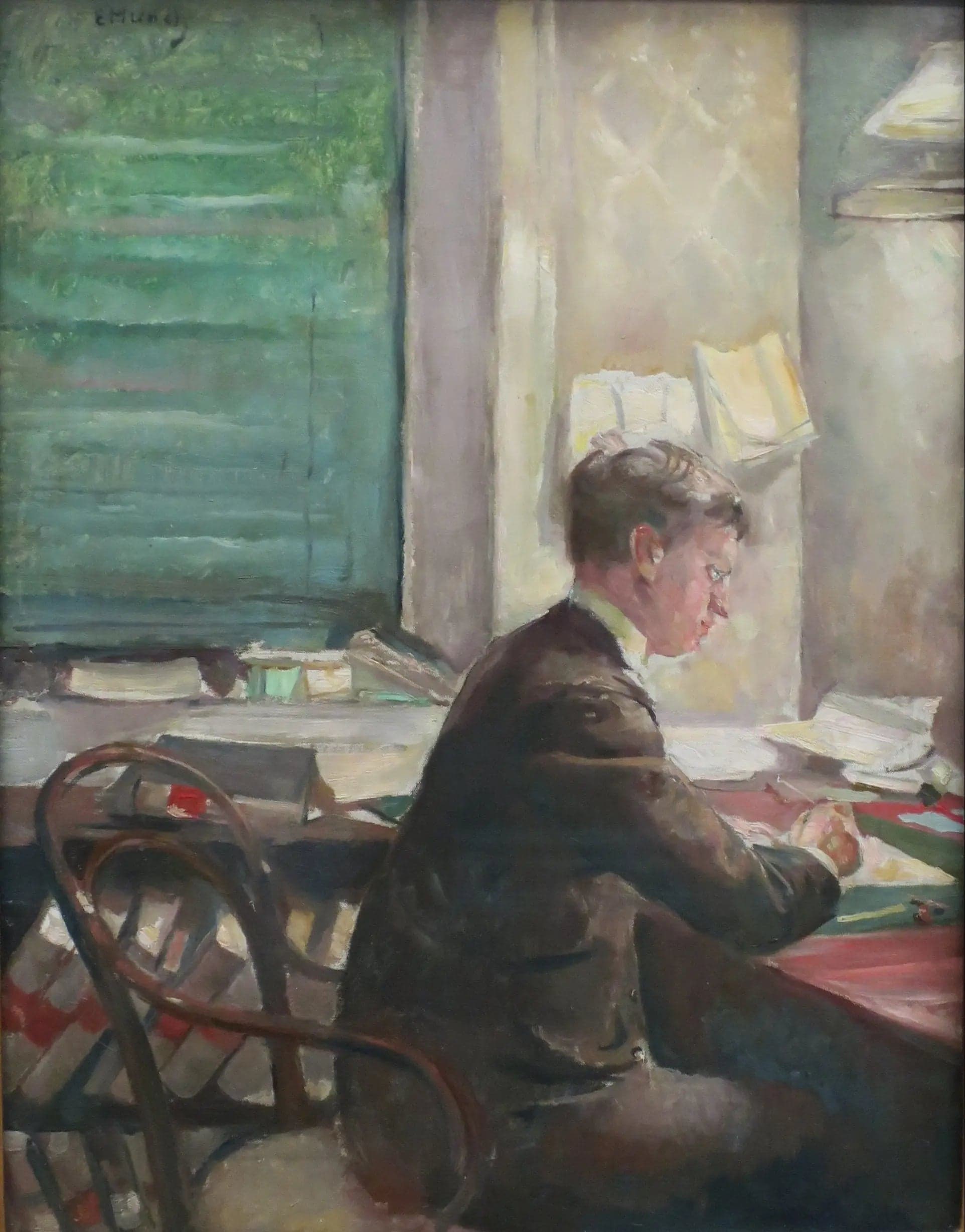
Halvard Stub Holmboe
- Original dimensions
- 59.3 x 76 cm
- Museum
- Bergen Art Museum
- Year
- 1887
Scene depicted
The canvas Halvard Stub Holmboe is a powerful evocation of the moment when reality meets dream. Munch, as a true master, captures the ephemeral sweetness of a suspended moment, where forms blend in an almost hypnotic way. This painting tells the story of a man carried by a delightful melancholy, his silhouette merging into a vibrant and lively backdrop, charging the scene with palpable emotion.
Historical context
Created in 1887 in the vibrant city of Bergen, this painting is at the heart of the expressionist movement, a current that explores introspection and the expression of emotions. As Europe is about to enter tumultuous ages, this canvas remains a witness to the artistic aspirations of its time. Today, this work is displayed at the Bergen Art Museum, where it attracts visitors and admirers, fascinated by its timeless pictorial message.
Place in the artist's career
At the heart of Munch's career, this canvas represents a pivotal moment, revealing the strength of his emerging style. Other masterpieces such as The Sick Child and The Scream show a progression towards a bolder artistic language. Halvard Stub Holmboe illustrates Munch's stylistic maturity, establishing a bridge between his legacy and future explorations of his talent.
Anecdote
According to reports, Munch once stated: “Painting is for me a means of communicating what I cannot express with words.” It is in a peaceful alley of Bergen that the inspiration for Halvard Stub Holmboe sparked, between a sunny morning where the scent of flowers echoed the light of an eternal spring. This pictorial work evokes this quest for inner beauty and authenticity, wrapped in a delicate atmosphere.