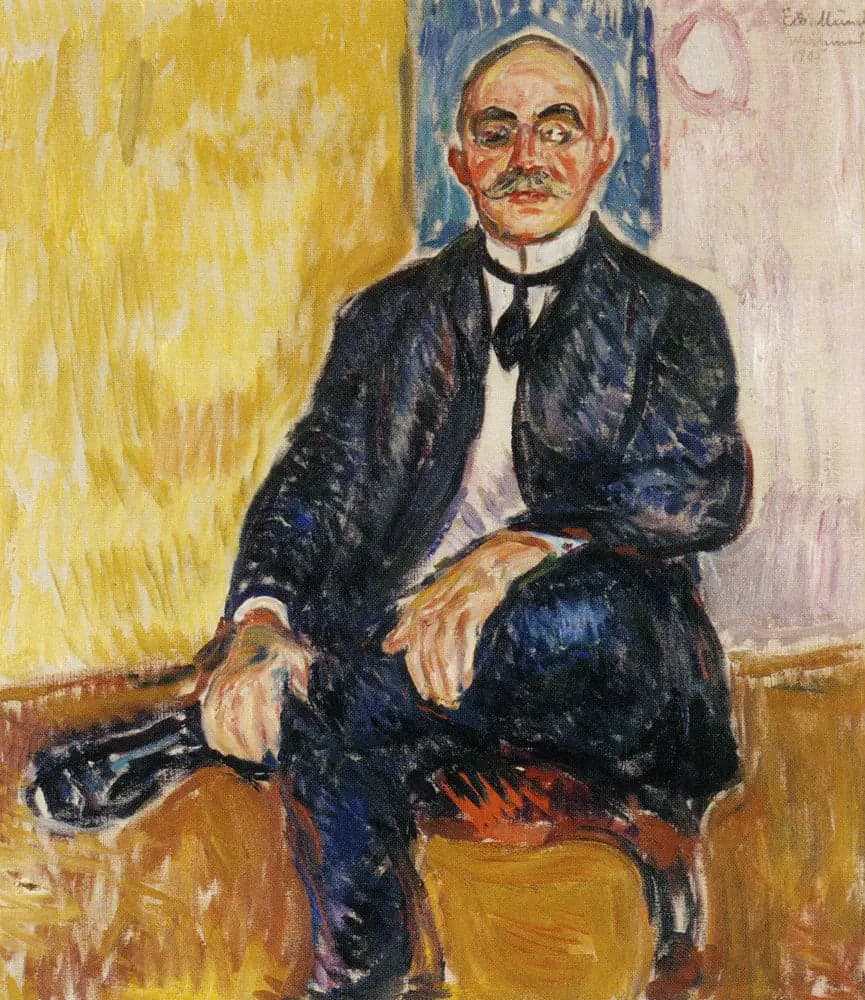
Gustav Schiefler
- Original dimensions
- 80 x 86 cm
- Museum
- Not specified
- Year
- 1908
Scene depicted
In this pictorial work, Munch depicts the portrait of a man imbued with melancholy, where the lines of his face blend with shadows, revealing a tormented soul. The composition is an exploration of psychological nuances, immersing the viewer in an atmosphere that is both serene and unsettling, creating a bridge between reality and the deep emotions of the artist.
Historical context
Created in 1908, this painting takes root in the vibrant heart of Oslo, then immersed in the meanders of symbolism , an artistic movement in full swing. Through Munch's canvas , we feel the pulse of an era marked by inner turmoil and reflections on human existence. This painting , although absent from major museums today, retains its captivating aura, testifying to the artist's unique sensitivity to the human condition, with dimensions of 80 x 86 cm that underscore its presence.
Place in the artist's career
“Gustav Schiefler” is situated at a pivotal moment in Munch's career, symbolizing an evolution in his approach to portraiture, while echoing works such as “The Scream” and “The Madonna” that preceded it. In these paintings , Munch tirelessly explores human nature, transforming his visions into poignant and unknotted reflections on life and death.
Anecdote
Munch once stated: “Every painting is an invitation to an inner journey.” This thought truly animated him during the creation of the masterpiece that the painting “Gustav Schiefler” represents. Imagine him, one spring morning, observing a soothing landscape while sketching the contours of an iconic figure, translating a delicate introspection that became vibrant through his painting .
Major exhibitions
Edvard Munch : portraits