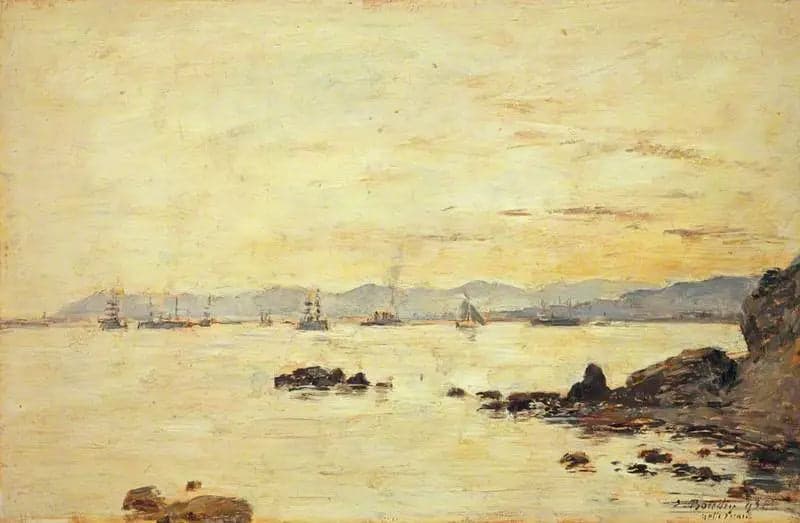
Gulf-Juan
- Original dimensions
- 41 x 27 cm
- Museum
- National Gallery of Scotland
- Year
- 1893
Scene depicted
The painting “Golfe-Juan” transports the viewer into a unique sensory experience. It captures the calm sea, white sails gently swaying in the breeze, and the coast in the background, a living tableau of fleeting moments where nature and man coexist in delightful harmony. Every detail in this scene invites us to breathe in the salty scent of the sea air and listen to the gentle lapping of the waves.
Historical context
Created in 1893, this painting is emblematic of Golfe-Juan, a gem of the Côte d’Azur that has inspired many artists. Eugène Boudin , master of plein air, places this painting within the Impressionist movement, at a time when light and color take on their full relief. The painting is currently on display at the National Gallery of Scotland, a museum that celebrates the genius of artists. Its dimensions, 41 x 27 cm, add a touch of intimacy to this pictorial work.
Place in the artist's career
This painting , at the crossroads of his career, perfectly illustrates the peak of a unique style. Compared to other works such as “La Plage à Trouville” and “View of Coastal Landscapes,” it reveals a technical evolution towards mastery of atmospheric effects, where light and color intertwine to create intense emotion.
Anecdote
“Every brushstroke is a dance with light,” said Boudin, evoking the moment of inspiration that led him to immortalize this landscape. Imagine a spring morning, the sea sparkling under the sun, where each wave whispers secrets of eternity, and the painting reveals itself as the mirror of this ephemeral beauty.