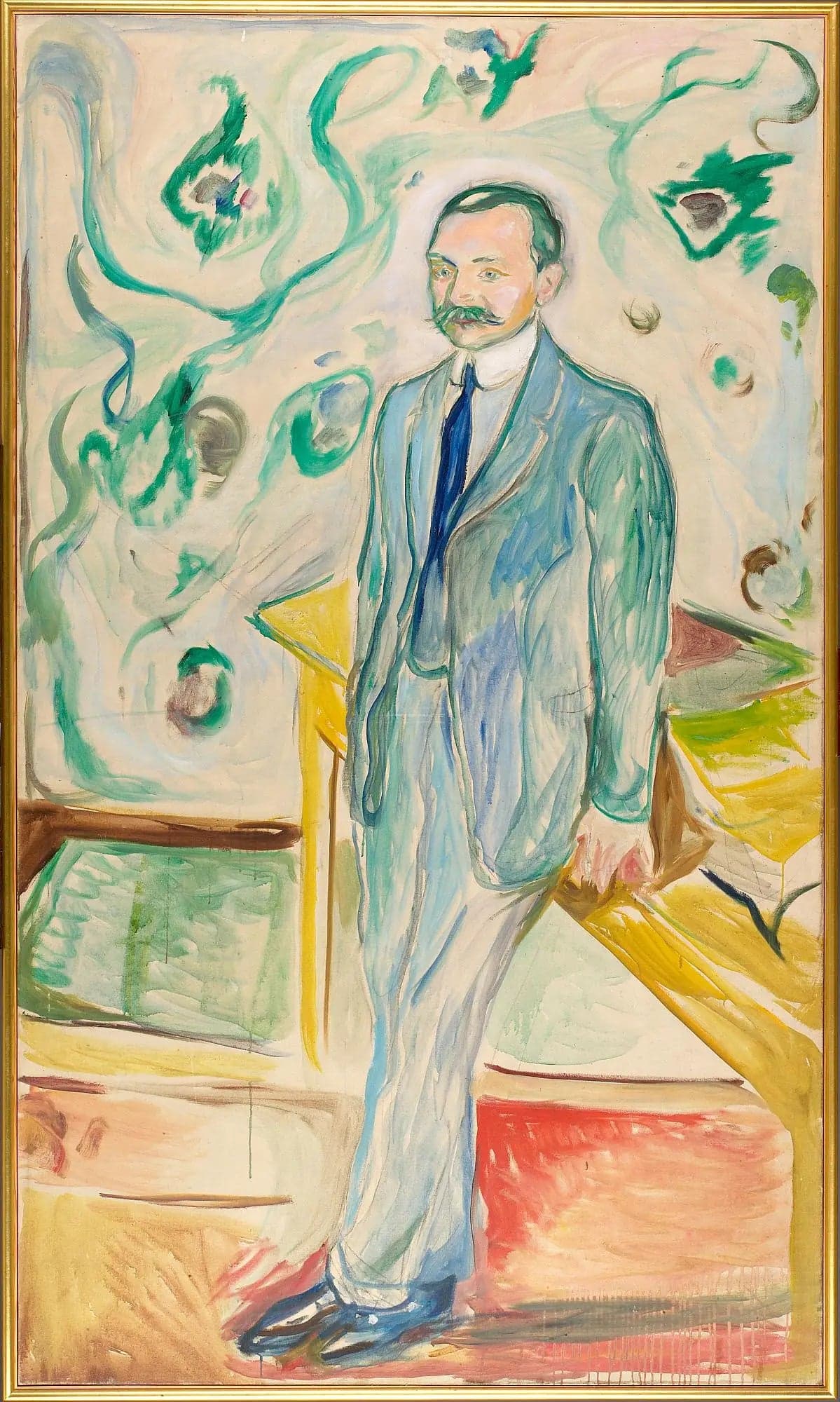
Guillaume Wartmann
- Original dimensions
- 111 x 190 cm
- Museum
- Munch Museum
- Year
- 1922
Scene depicted
This canvas offers a complex composition often interpreted as an exploration of human anxiety and the fleeting beauty of existence. Through figures with both serene and tormented faces, Munch captures the essence of social interactions and human emotions, making each gaze at the masterpiece a fully immersive experience.
Historical context
Created in 1922, this painting is part of the expressionist movement, characteristic of the work of Edvard Munch . Located in Oslo, Norway, within the Munch Museum, this pictorial work is a strong symbol of the resentment of its time. With dimensions of 111 by 190 cm, this canvas reveals itself as a voice for human emotions, a true gem in the vast landscape of modern art.
Place in the artist's career
“Guillaume Wartmann - Edvard Munch ” represents an advanced phase of Edvard Munch 's career, exploring themes of anxiety and desire. In resonance with works such as “The Scream” and “The Madonna,” this canvas illustrates the artistic evolution of a master whose technique and sensitivity continue to fascinate. This moment represents the peak of a journey that Munch had begun to chart many years earlier.
Anecdote
“Art must not reproduce nature, but make it alive,” Munch liked to say. This quote captures the very essence of painting . The day he conceived this masterpiece , immersed in a daydream on a spring morning, he let the sunlight filter through the clouds, revealing the emotional depth he wished to capture in this canvas .
Major exhibitions
Edvard Munch : portretter