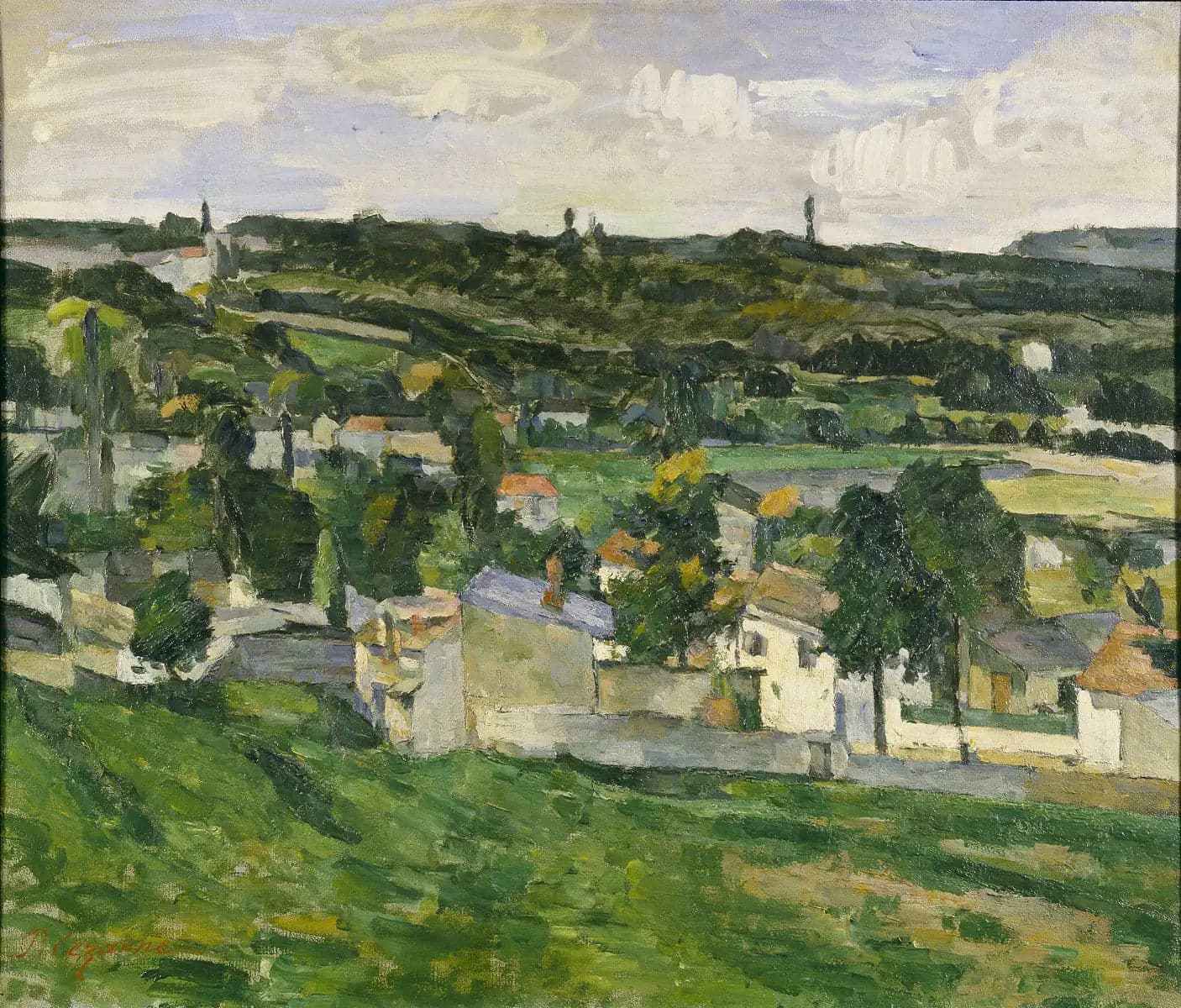
Group of Houses, Île-de-France Landscape
- Original dimensions
- 55 x 46 cm
- Museum
- unknown
- Year
- 1879
Scene depicted
This pictorial work represents a landscape of the French countryside, where a group of houses stands gracefully. Cézanne, as a master of the emerging cubism , redefines the way to perceive reality, capturing the geometric lines of the facades and the harmony between architecture and the surrounding nature. The gaze is drawn to the palette of earthy tones that invites us to contemplate the tranquility of the place.
Historical context
Created in 1879, the painting "Group of Houses, Landscape of Île-de-France" is an emblematic work of an artist who captured the very essence of French nature. Located in Île-de-France, a favored area by the impressionists , this masterpiece is part of Cézanne's maturation period, where he combined elements of local reality with his unique style. Although the painting is currently lost to the public, its dimensions of 55 x 46 cm make it an intimate painting that resonates in the hearts of admirers.
Place in the artist's career
"Group of Houses, Landscape of Île-de-France" occupies a decisive crossroads in Cézanne's career, marking a promising beginning in the exploration of forms and colors. In parallel with other works such as "The Montagne Sainte-Victoire" and "The Large Bathers," this painting reveals the technical and emotional evolution of the artist, illustrating his journey towards conscious abstraction.
Anecdote
"Nature is an open book; you just have to know how to read it." such could be an inspiring quote attributed to Cézanne, reflecting the moment he painted this masterpiece . Imagine a spring morning, enveloped in the soft light of the first rays, he observes how the sun caresses the slate roofs, awakening the colors to the melody of a deep silence.