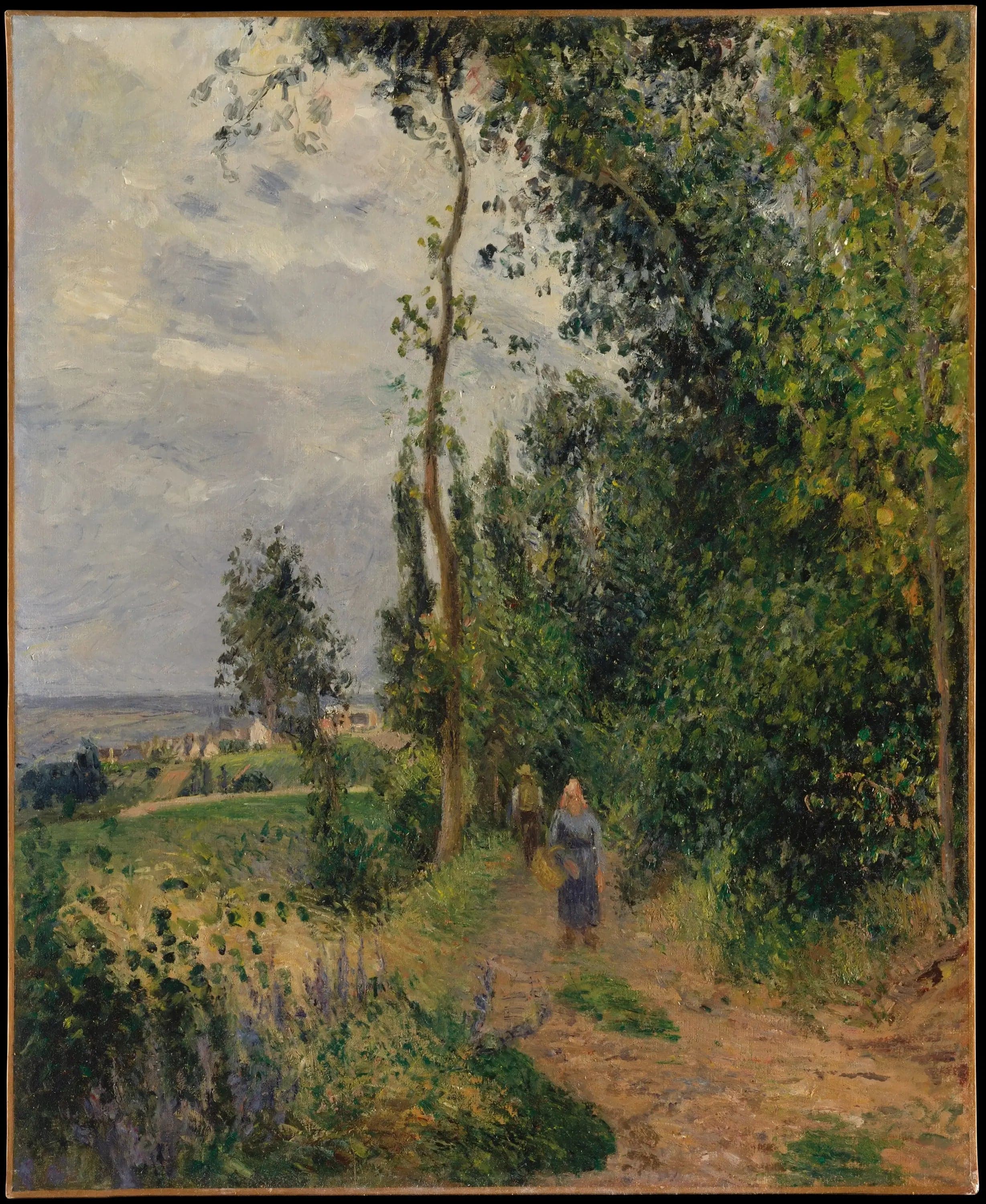
Groouettes Coast, near Pontoise
- Original dimensions
- 60 x 74 cm
- Museum
- Metropolitan Museum of Art
- Year
- 1878
Scene depicted
The painting "Côte des Groouettes, près de Pontoise" depicts a serene scene where nature flourishes freely. The gentle hills rise in the background, embracing a sky of azure, while the sunlight dances on the leaves of the trees. Each brushstroke tells a story, that of the intimate relationship between man and his environment, revealing the fragile harmony that reigns there.
Historical context
Created in 1878, this painting is set in the bucolic framework of Pontoise, a city rich in history located in the Île-de-France region. Côte des Groouettes, près de Pontoise is an emblematic work of the Impressionist movement, which sought to capture natural light and scenes of everyday life. Currently, this canvas is preserved at the Metropolitan Museum of Art , where it testifies to a precise moment in the evolution of modern art.
Place in the artist's career
This painting marks a crucial step in Pissarro's career. As a stylistic peak of his Impressionist period, it stands out alongside his other works such as "Boulevard Montmartre, spring" and "The Potato Harvest." The development of his technique and vision is reflected in this composition , where each element conveys a new emotion.
Anecdote
Camille Pissarro once stated: "Nature is a treasure of emotions to paint." It is precisely this feeling that overwhelmed him as he stood on the Côte des Groouettes, one gentle spring morning, when the light embraced the curves of the landscape, painting the picture of his inspiration. This canvas is an invitation to experience the very essence of that moment, capturing the whisper of the wind and the scent of blooming flowers.