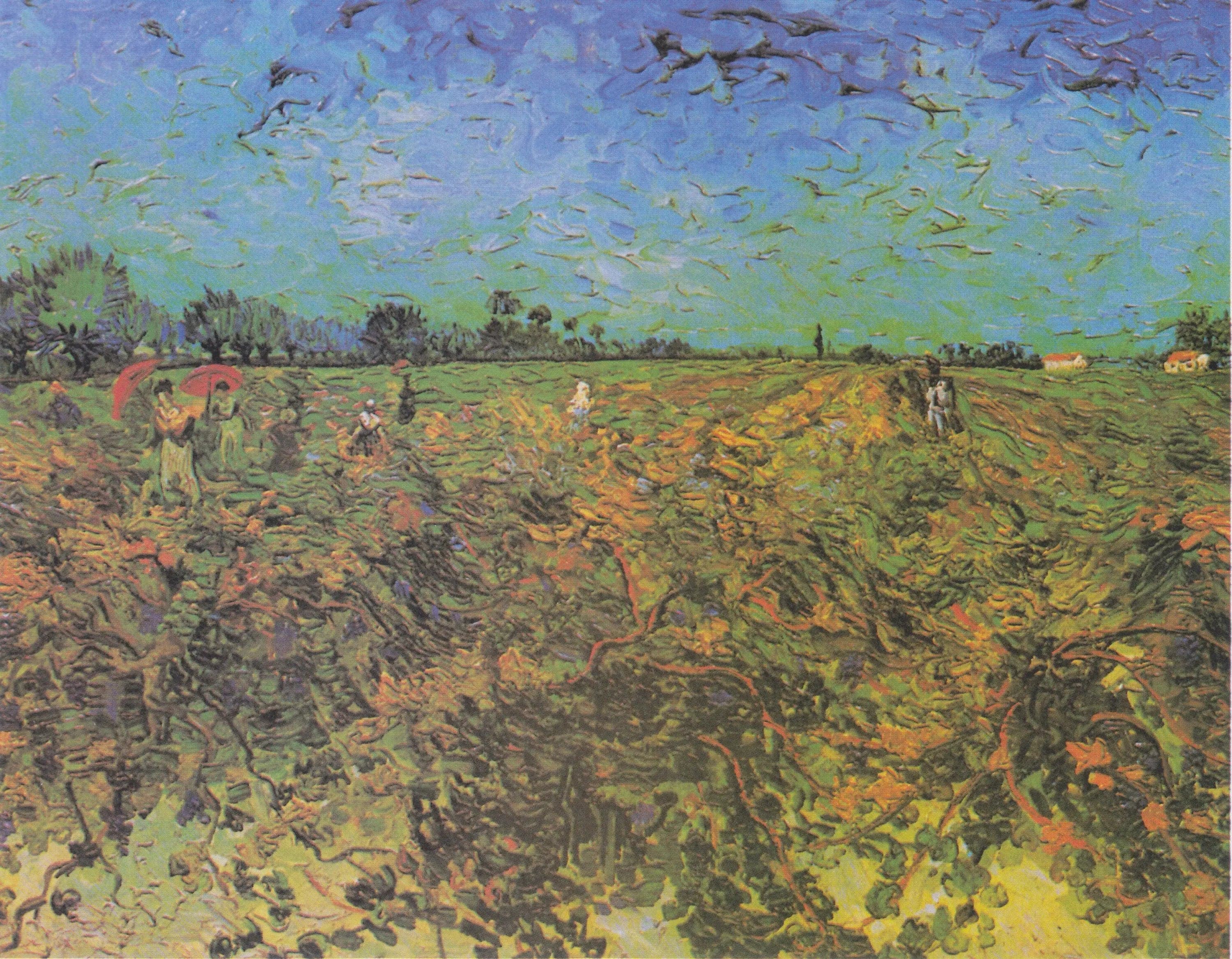
Green Vineyard
Scene depicted
The composition of Green Vine illustrates a glorious pagoda of lush foliage, painted with frenetic energy. The streaks of color, sometimes green, sometimes golden, evoke the richness of the vines in full growth, testifying to van Gogh's unparalleled talent for capturing the nuances of nature. This work conveys a deep connection to the terroir, an echo of the artist's feelings towards his environment. Every detail, from the delicate leaves to the subtly placed shadows, tells a story of vitality and growth.
Historical context
Created in 1888, the iconic painting Green Vine finds its origin in the charming city of Arles , France. This work is a striking example of post-impressionism , an artistic movement that resonates with the sensitivity and emotion of its time. Currently, this canvas is preserved at the Kröller-Müller Museum , where its radiance continues to inspire admirers and art enthusiasts. The dimensions of this canvas are 92 x 72 cm, conducive to revealing the richness of its pictorial universe.
Place in the artist's career
Green Vine is part of a flourishing period in the career of Vincent van Gogh , marking his ascent towards a more complete artistic mastery. While his painting The Sunflowers testifies to his sense of color, and The Starry Night demonstrates his impressive work on light, Green Vine embodies the perfect harmony between nature and emotion, a true symbol of van Gogh's artistic genius.
Anecdote
“I feel alive among these vines,” said van Gogh, as he captured the magic of a sunny morning, where the vines stretched out before him under a blue sky. A symphony of colors mingled with the warm air, inspiring this canvas where the vibrant green of the leaves seems to vibrate under the caress of a light breeze. This frozen moment, a resonance of his passion, transforms the painting into an ode to the simple pleasures of nature.