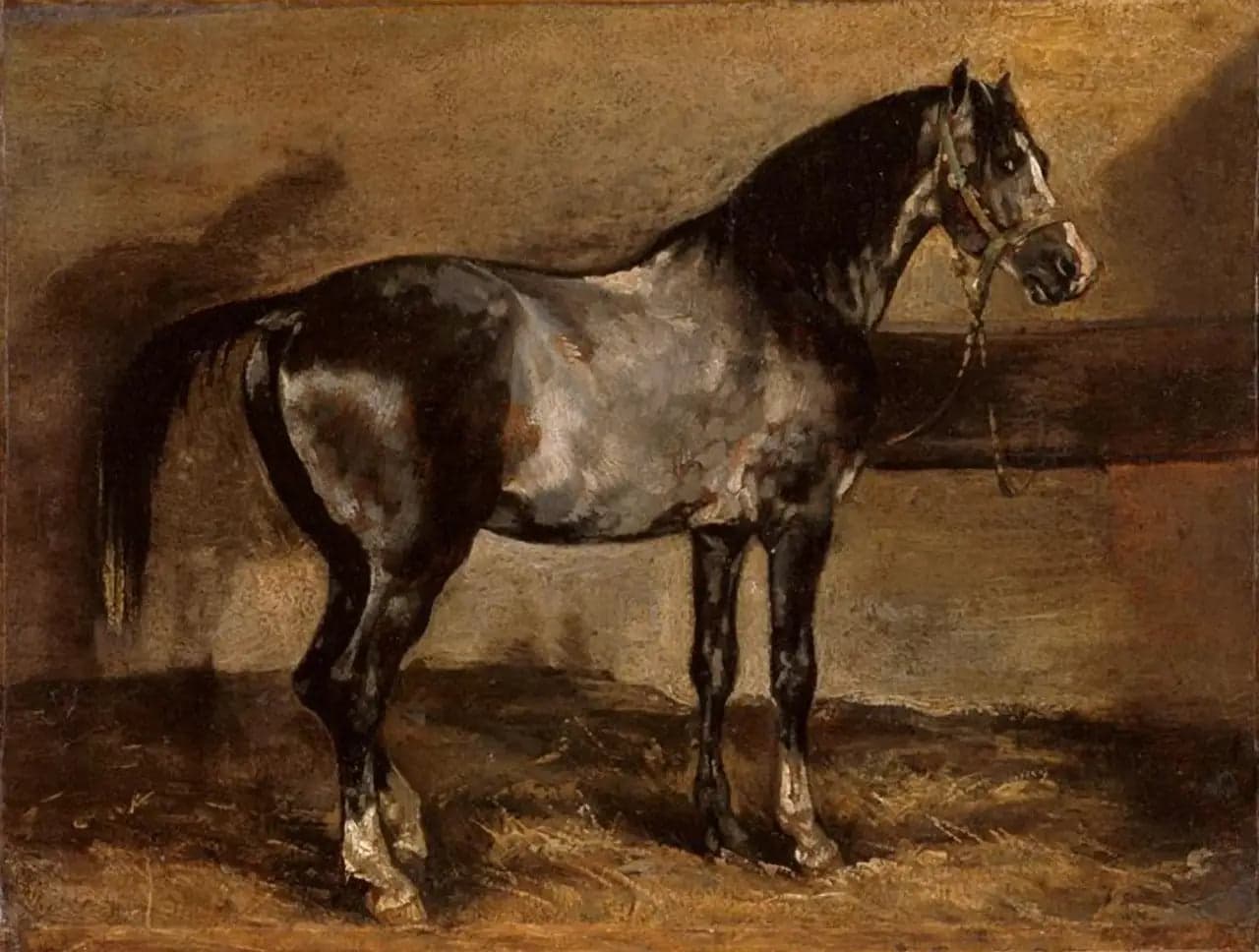
Gray Horse at the Hayrack
- Original dimensions
- 34 x 26 cm
- Museum
- room 941
- Year
- 1811
Scene depicted
The composition of Gray Horse at the Hayrack unveils a moment of intimacy between the animal and its environment. The horse, a noble creature, stands majestically before its hayrack, illustrating both power and vulnerability. Géricault captures the very essence of this moment, oscillating between realism and emotion, offering the viewer an almost tactile immersion in the equestrian world.
Historical context
Artwork: Gray Horse at the Hayrack |BRK| Artist: Théodore Géricault |BRK| Year: 1811 |BRK| Museum: room 941 |BRK| Dimensions: 34 x 26 cm |BRK|
Place in the artist's career
Gray Horse at the Hayrack stands as a milestone in Géricault's career, marking his rise within the romantic movement. In parallel, two other works, The Raft of the Medusa and Portrait of the Artist , illustrate this evolution, oscillating between tragic expression and a sense of beauty imbued with melancholy. This painting testifies to the technical and emotional mastery that would become the artist's signature.
Anecdote
Théodore Géricault , passionate about the equestrian world, reportedly stated: “The horse is a living poem,” a phrase that resonates deeply in the strength and dynamics of his masterpiece . On a sunny afternoon, while observing horses in a stable, the artist was struck by the majesty and elegance of the beast. This moment of inspiration became the very heart of this painting , revealing the raw and wild beauty of the animal.